



This guide is intended for educational and informational purposes only to address disciplinary issues under the authority of the State Bar of Texas. The Guide does not constitute legal, accounting, or professional advice and no liability is assumed in connection with the information, suggestions, opinions, or links provided.
Thank you to the Washington State Bar Association for permission to use its illustrations from Managing Client Trust Accounts—Rules, Regulations, and Common Sense.
Updated January 2024
Introduction
Rule 1.15 of the Texas Disciplinary Rules of Professional Conduct titled “Safekeeping Property” is commonly referred to as the trust account rule. This Guide discusses the proper handling of monetary funds belonging entirely or partially to a client or third person that, as required by the rule, must be kept separate from the lawyer’s own funds by depositing the funds into a trust account. As discussed in this Guide, a trust account may be one or more interest-bearing trust accounts or Interest on Lawyers’ Trust Accounts (IOLTA).[1]
Lawyers also have operational accounts, which are not subject to the disciplinary rules and are not addressed in this Guide. Operational accounts are commonly used to pay law firm expenses, including the lawyer’s income. Appropriate deposits to an operational account include the lawyer’s earned fees and reimbursed expenses.
1.15 Safekeeping Property
(a) A lawyer shall hold funds and other property belonging in whole or in part to clients or third persons that are in a lawyer’s possession in connection with a representation separate from the lawyer’s own property. Such funds shall be kept in a separate account, designated as a “trust” or “escrow” account, maintained in the state where the lawyer’s office is situated, or elsewhere with the consent of the client or third person. Other client property shall be identified as such and appropriately safeguarded. Complete records of such account funds and other property shall be kept by the lawyer and shall be preserved for a period of five years after termination of the representation.
(b) Upon receiving funds or other property in which a client or third person has an interest, a lawyer shall promptly notify the client or third person. Except as stated in this Rule or otherwise permitted by law or by agreement with the client, a lawyer shall promptly deliver to the client or third person any funds or other property that the client or third person is entitled to receive and, upon request by the client or third person, shall promptly render a full accounting regarding such property.
(c) When in the course of representation a lawyer is in possession of funds or other property in which both the lawyer and another person claim interests, the property shall be kept separate by the lawyer until there is an accounting and severance of their interest. All funds in a trust or escrow account shall be disbursed only to those persons entitled to receive them by virtue of the representation or by law. If a dispute arises concerning their respective interests, the portion in dispute shall be kept separate by the lawyer until the dispute is resolved, and the undisputed portion shall be distributed appropriately.
(See Appendix 1 for Rule 1.15 and comments.)
Policy Behind the Rule
The policy behind Rule 1.15 is to safeguard funds that do not belong to the lawyer. When a lawyer holds funds that belong to a client or third party, these funds must be protected from the lawyer’s creditors or personal financial problems. When acting as a fiduciary, lawyers are required to treat the property of others with the highest standards of accountability. Rule 1.14 details a lawyer’s duties to clients and third persons in this capacity. The obligation to keep the property of others in a separate trust account in accordance with Rule 1.14 is absolute and not waivable.
Although Rule 1.15 also mentions the duty to safeguard “other property,” the purpose of this Guide is to discuss safeguarding funds, not personal property like jewelry or stock certificates.
[1] Tex. Gov’t Code Ann., tit. 2, subtit. G, app. A (effective July 1, 1989); Tex. State Bar R. art. XI, § 5 (as amended December 2022).
In connection with a representation, if a lawyer handles funds that belong to a client or third person, those funds must be held in a separate “trust” or “escrow” account, regardless of whether the funds belong in whole or in part to the client or a third person. A lawyer may accept many methods of payment, including cash, check, or credit card.
Types of Funds
Funds that must be deposited in a trust account:
- Any unearned fee, including advances for fees and most retainers, until they are earned by the lawyer.
- Funds that belong in part to the client and in part to the lawyer.
- Funds of the client to be disbursed at a later time.
- Funds of third parties to be distributed at a later time.
Examples include:
- Advance fee/expense deposits
- Settlement monies
- Overpayment of bills
Funds that must not be deposited in a trust account:
- Fully earned fees
- Any funds that belong wholly to the lawyer
Examples include:
- Reimbursements for cost advances
- Lawyer’s personal or business transactions
Unearned Fees, Fully Earned Fees, and Commingling Funds
Unearned Fees
Any unearned fee or advance payment of expenses must be deposited into a trust account. Unearned fees are subject to refund until earned and cannot be deemed nonrefundable, even by agreement.
Examples of unearned fees include:
- An advance deposit or retainer for lawyer’s fees that will be depleted as the lawyer bills the client on an hourly basis. (See Appendix 2 for Ethics Opinion 611.)
- Flat fees that have not been earned, regardless of whether the fee is deemed “nonrefundable” in the fee agreement. (See Appendix 3 for Cluck v. Comm’n for Lawyer Discipline.)
- Settlement funds which have not been distributed in accordance with the contingent fee requirements in Rule 1.04 (d). (See Appendix 4 for Rule 1.04 (d).)
Fully Earned Fees
Fully earned fees are funds received in payment for work already performed. For example, when a client pays the exact amount invoiced for work performed by the lawyer, that money has been earned. Fully earned fees should be deposited in the attorney’s operational or personal account, not a trust or IOLTA account.
Commingling Funds
A lawyer should not commingle fully earned fees, her personal funds, or the law firm’s funds with client or third-party funds to comply with the requirement in Rule 1.15 that client and third-party funds be kept separate from the lawyer’s own property. A lawyer cannot ask a client to commingle funds or place funds in a joint account when they should be placed in a trust account, nor can the lawyer agree to a client’s request to do so. However, there is an exception to the general prohibition against commingling that allows the lawyer’s or law firm’s funds that are “reasonably sufficient to pay for fees or obtain a waiver of fees or to keep the account open” to be deposited into the trust account.
Fee Arrangements
Rule 1.15 applies regardless of the type of fee agreement between lawyers and their clients, whether it involves an hourly fee, flat fee, contingent fee, or prepayment of an expense, and regardless of what the billing arrangement is called. For example, “value billing” is based on the results delivered to the client. The rule also applies to any practice area, whether it is criminal, family, personal injury, corporate law, etc. A trust account must be used in these circumstances because the rule is clear and straightforward: until the fee is earned, it must be segregated from the lawyer’s own funds in a trust account.
Questions often arise about flat fees and when they are earned. Simply stating that a flat fee is nonrefundable or earned upon receipt does not make it so. Unless the fee agreement states specific benchmarks at which the flat fee is earned, lawyers should operate under the premise that none of the fee is earned until the representation ends and all work has been completed to meet the client’s objective.
If a lawyer does not complete the representation due to termination by the client or voluntary withdrawal, the lawyer may face a situation where only some work has been completed, making it difficult to determine what portion of the flat fee has been earned. A lawyer can avoid this problem by stating the benchmarks at which the fee is earned in the fee agreement. For example, the lawyer could include their hourly rate or a schedule of work to be completed that designates at each step what portion of the fee has been earned.
True Nonrefundable Retainers vs. Advanced Deposits/Retainers
A true nonrefundable retainer is a fee to secure a lawyer's services and remunerate him for the lost opportunity of accepting other employment. It is not a payment for services. Only a true retainer may be nonrefundable. If the lawyer can substantiate that other employment will probably be lost by obligating himself to represent the client, the retainer fee should be deemed earned when it is received. As an earned fee, a true nonrefundable retainer should be placed in the lawyer’s operational account and not in a trust account.
A true nonrefundable retainer is distinguishable from an advanced deposit or prepayment retainer. If the lawyer will perform services for the fee, the fee is classified as an advanced deposit or prepayment for services, which is always refundable until it has been earned through the performance of legal services.
As with a flat fee, a lawyer cannot transform an advance deposit or prepayment into a nonrefundable retainer simply by declaring that it is nonrefundable or stating that the fee is to remunerate the attorney for lost opportunity of other employment. Because it remains the client’s property, it must be placed in the lawyer’s trust account.
If a lawyer receives funds from a client that is comprised of both a nonrefundable retainer fee and an advance payment for future services, only the payment meeting the requirements for a true nonrefundable retainer may be deposited into the lawyer’s operating account. The remainder must be deposited into a trust account.
Advanced Payments of Expenses
It is much easier to identify what constitutes an advance payment of expenses than an unearned fee. For example, court costs, such as filing fees, are often paid as part of an advance payment of fees. Until the court costs are paid, they belong in a trust account. The same is true of anticipated travel expenses. Until the lawyer buys the plane ticket or reimburses himself, the money for this expense remains in the trust account. Once the expense is reimbursed, the funds are transferred to the lawyer’s operational account.
The terms “IOLTA account” and “trust account” are not synonymous. An IOLTA account is simply a type of trust account. All IOLTA accounts are trust accounts, but not all trust accounts are IOLTA accounts.
When placing funds in a trust account, the lawyer must first determine whether the trust account should be set up as an individual interest-bearing trust account or an IOLTA trust account. The difference between the two types of trust accounts relates to who receives the interest earned on the principal funds. All interest earned, just like the principal funds, belongs to the beneficiary of the trust account.[1] A lawyer may not keep any interest earned.
Individual Interest-Bearing Trust Accounts
An individual interest-bearing trust account is set up to benefit the person to whom the funds belong, which is usually the client. The general rule is that funds should be placed in an individual interest-bearing trust account when they can reasonably earn interest for the beneficiary.[2] If the funds cannot reasonably earn interest for the beneficiary, the funds go into an IOLTA trust account.[3]
When opening an individual interest-bearing trust account, it is important that the lawyer use the beneficiary's social security number or EIN. For IRS reporting purposes, the lawyer should not use his own tax ID number on this type of account.
IOLTA Trust Accounts
Rule 1.15 makes clear that funds belonging to clients and third parties must be held in trust. However, in some situations, it could be very burdensome for a lawyer to hold funds for each person in separate individual interest-bearing trust accounts. A lawyer could place the funds of multiple beneficiaries in one trust account but interest and account expense calculations for each beneficiary would be difficult and time-consuming, especially if funds were regularly deposited and withdrawn for each beneficiary.[4] Use of an IOLTA-type trust account alleviates these problems.
An IOLTA trust account operates to pool the separate beneficiaries’ funds in one account. A lawyer should use an IOLTA account when the beneficiary’s funds are nominal or only expected to be held for a short period of time.[5] These types of funds cannot reasonably earn interest for the client, so the interest earned on IOLTA accounts is paid to the Texas Access to Justice Foundation for the provision of legal services to the indigent in civil matters.
|
Nominal in Amount or |
This practice has been upheld as permissible[6] and is required under Article XI of the State Bar Rules.[7]
The IOLTA Rule
Article XI of the State Bar Rules requires attorneys to put client funds that are nominal in amount or reasonably anticipated to be held for a short period of time in an IOLTA trust account because these funds cannot reasonably earn interest for the client.[8]
Compliance with the IOLTA Rules
Lawyers who use an IOLTA account are subject to additional requirements under the IOLTA rules,[9] which include:
- Notice to financial institution from lawyer[10]
(See Appendix 5 for form.)
- Annual compliance on State Bar of Texas dues statement[11] (See Appendix 6 for form.)
- Notice of IOLTA changes, such as closing an account or opening a new account at a different financial institution[12]
Errors in Placement of Funds
If a lawyer makes an error and places funds into an IOLTA trust account when they should have been placed in an individual interest-bearing trust account, the lawyer should contact the Texas Access to Justice Foundation. The Texas Access to Justice Foundation has procedures to refund the interest received, so that the interest can be paid to an individual beneficiary. The Texas Access to Justice Foundation website has information, forms, and Frequently Asked Questions related to IOLTA accounts.[13]
[1] See Tex. Comm. on Prof’l Ethics, Op. 404, 45 Tex. B.J. 1132 (1982).
[2] Id.; Tex. Comm. on Prof’l Ethics, Op. 421, 48 Tex. B.J. 208 (1985).
[3] See Tex. Comm. on Prof’l Ethics, Op. 421, 48 Tex. B.J. 208 (1985); Rules Governing the Operation of the Texas Access to Justice Foundation, §4.
[4] See Tex. Comm. on Prof’l Ethics, Op. 421, 48 Tex. B.J. 208 (1985).
[5] Tex. State Bar R. art. XI, §5; Rules Governing the Operation of the Texas Access to Justice Foundation, §4.
[6] See Tex. Comm. on Prof’l Ethics, Op. 421, 48 Tex. B.J. 208 (1985). See also Brown v. Legal Foundation of Washington, 538 U.S. 216 (2003), regarding a similar IOLTA program in Washington State.
[7] Tex. State Bar R. art. XI, § 5 (as amended December 2022).
[8] Id. See also www.teajf.org/attorneys/do_you_need_an_iolta_account.aspx.
[9] See generally Tex. State Bar R. art. XI; Rules Governing the Operation of the Texas Access to Justice Foundation.
[10] Find form at www.teajf.org/attorneys/docs/iolta_notice_form.pdf.
[11] Rules Governing the Operation of the Texas Access to Justice Foundation, §23.
[12] Rules Governing the Operation of the Texas Access to Justice Foundation, § 5.
Choosing a financial institution for your trust account is important. Factors to consider include how much federal deposit insurance is offered by the financial institution, whether the financial institution is eligible to participate in the IOLTA program administered by the Texas Access to Justice Foundation, fees, locations, and convenience.
Federal Deposit Insurance
Rule 4 of the Rules Governing the Operation of the Texas Access to Justice Foundation requires lawyers to deposit trust funds into a federally insured checking account or investment product, such as an interest-bearing account at an investment firm like Morgan Stanley.[1] The federal government insures bank accounts through the Federal Deposit Insurance Corporation (FDIC). Investment firms insure interest-bearing accounts through government securities, not the FDIC.
All funds in IOLTA accounts at Insured Depository Institutions are insured under the FDIC. As of January 1, 2013, the standard FDIC insurance coverage limit is $250,000 per depositor, per FDIC-insured bank, per ownership category.[2] Because the FDIC considers IOLTA and other lawyer and law firm trust accounts as fiduciary accounts, the per depositor coverage means that funds of individual clients and third persons in a trust account will be fully insured up to the $250,000 maximum, which includes any funds in the same ownership category, like a checking or savings account, that a client or third person also has on deposit at the same insured depository institution.[3] The FDIC has more information online at: www.fdic.gov/deposit/deposits/changes.html.
FDIC insurance coverage is important when dealing with large sums of money for clients. A lawyer should determine if the client has other funds on deposit at the same bank where the trust account is established and the type of accounts that the client has, because the depositor’s other accounts and the trust account may be cumulative for purposes of FDIC insurance.[4] For example, if the client has a personal checking account, personal savings account, and business checking account at the bank where the trust account is held, the funds in those accounts would be added to the amount held in trust for the client to determine if the total exceeds the $250,000 FDIC insurance limit. If so, a lawyer may wish to consider placing that client’s funds in two or more separate trust accounts at different banks for the entire amount to be insured.[5] However, if the client has funds at the bank in another ownership category, such as a certificate of deposit, or has an account at the bank that does not qualify for FDIC insurance, those funds would not count toward the $250,000 limit.[6] Additional information on FDIC limits can be found on the FDIC website.[7]
Eligible Financial Institutions for IOLTA Accounts
The Texas Access to Justice Foundation determines which financial institutions are eligible to hold IOLTA accounts.[8] A lawyer may establish an IOLTA account at any eligible financial institution. Some eligible financial institutions, referred to as Prime Partners, have agreed to pay, net allowable reasonable fees, a higher interest rate on IOLTA accounts at the higher of 1) 75.00% or more of the Fed Funds Target Rate or 2) a minimum of 1.00% on IOLTA accounts. The higher interest earned on IOLTA accounts at Prime Partner banks increases funds available to provide legal services to low-income Texans in civil matters. The Texas Access to Justice Foundation lists approved financial institutions at: www.teajf.org/financial_institutions/docs/Eligible_Banks_List_Master.pdf.
Out-of-State Trust Accounts
A lawyer is required by Rule 1.14 (a) to maintain all trust accounts in the “state where the lawyer’s office is situated, or elsewhere with the consent of the client or third person.” While a lawyer may obtain the client or third party’s consent to use a bank in another state, a lawyer cannot ask the client or third person to consent to commingling or keeping funds in a non-trust type account, such as a joint checking account.[9]
[1] For further information about permissible investment products which comply with Rules Governing the Operation of the Texas Access to Justice Foundation, §4, contact: Texas Access to Justice Foundation at (800) 252-3401 (Texas calls only), or (512) 320-0099 (for calls from outside of Texas), or www.teajf.org.
[2] See Deposit Insurance FAQs on the Federal Deposit Insurance Corporation’s website at www.fdic.gov/resources/deposit-insurance/faq/#:~:text=Q%3A%20How%20much%20deposit%20insurance,insured%20bank%2C%20per%20ownership%20category.
[3] Id.
[4] Id.
[5] Id.; Patricia A. Sallen & Shauna R. Miller, Client Trust Accounts and the Financial Crisis, 71 Tex. B.J. 906-08 (2008).
[6] Id.
[7] For additional information on FDIC limits, visit www.fdic.gov/resources/deposit-insurance/faq/#:~:text=The%20standard%20deposit%20insurance%20coverage,held%20at%20the%20same%20bank. For additional information on FDIC ownership categories, visit www.fdic.gov/resources/deposit-insurance/brochures/insured-deposits/.
[8] Rules Governing the Operation of the Texas Access to Justice Foundation, §7.
[9] See supra note 3; Brown, 980 S.W.2d at 679-80.
Opening the Trust Account
After reviewing the information in the “Financial Institutions” section, the lawyer should determine which financial institution or, in some cases, investment firm to use for trust account purposes.
When opening an IOLTA account, the lawyer must use the Texas Access to Justice Foundation’s tax identification number, 74-2354575, because it receives the interest. Within 30 days of establishing an IOLTA account, the lawyer must also complete the mandatory “IOLTA Notice to Financial Institution and Foundation” form, which enables the account to be exempt from backup withholding and from reporting interest income to the Internal Revenue Service.41 The account should be titled in the lawyer’s or law firm’s name with the words, “Client Trust Account,” “IOLTA Account,” or “Client Escrow Account.” For interest-bearing, individual client trust accounts only, the accounts should be titled “Lawyer’s Name as Custodian for Client’s Name.”[42] Lawyers who practice in a law firm or professional corporation may use the firm’s or corporation’s trust account without having to open a trust account specific to the individual lawyer.[43]
When opening interest-bearing accounts established on behalf of specific clients, the lawyer should use the client’s tax identification number or social security number, which allows the financial institution to issue a 1099 tax form to the IRS in the client’s name to report the interest income. If the bank sends the client’s 1099 to the lawyer, the lawyer has a duty to promptly forward it to the client.[44]
Signatories
Only the lawyer or people under the lawyer’s direct supervision may sign on the trust account.[45] The client cannot be a signer even if the account is in the client’s name.
A lawyer may want to have another signer on the trust account. It can be important when, for reasons such as a lack of Internet access or simply not being physically present to endorse a check, the lawyer cannot make a time-sensitive disbursement or deposit. IOLTA accounts and interest-bearing trust accounts do not require the second signer to be a lawyer. Be aware that the lawyer is responsible for the conduct of other lawyers and staff regarding trust funds under the disciplinary rules. Adequate supervision is essential.[46]
It is also important to know that the right of a signer end immediately upon the account owner’s death.
Trust Account Fees
It is the lawyer’s responsibility to pay the costs of check orders, bank fees, insufficient fund fees, and other fees that may be deducted from the trust account. The lawyer should anticipate these expenses and deposit a reasonable amount of money into the trust account to cover the expenses before their deduction.[47]
As previously stated, a lawyer may deposit their own funds into the trust account if they are “reasonably sufficient to pay for fees or obtain a waiver of fees or to keep the account open.” This exception has limitations. A lawyer cannot place funds into the trust account to provide a “cushion” for potential withdrawals that would exceed the amount needed for these nominal fees, such as additional funds to protect against overdrafts or hot checks.[48]
When purchasing trust account checks, the lawyer may want to consider ordering checks that are a different color or design from the lawyer’s operational account, so it is easy to tell the difference between the two accounts.
Maintaining the Trust Account
Remember these three simple rules:
- No commingling!
- Identify each clients’ deposits and disbursements to create a record, regardless of whether you make a wire or phone transfer, or bank online.
- Reconcile, reconcile, reconcile!
Deposits
A deposit slip should identify each client by name or file number. Deposits should be recorded in chronological order in the check register or similar electronic record.
Disbursements
Disbursements should be made according to the fee agreement between the lawyer and client. Rule 1.04 (d) of the Texas Disciplinary Rules of Professional Conduct requires a contingent fee agreement to be in writing[49] and Rule 1.04 (f) requires a written fee agreement when two lawyers at separate firms intend to share fees while performing legal services for the same client.
In many cases, a fee agreement is not required to be in writing. However, it is highly recommended that the lawyer has a written fee agreement with every client to avoid disputes between them regarding the lawyer’s fees, expenses, or payments to third parties on behalf of the client. Under Rule 1.14 (c), a lawyer must hold disputed funds in a trust account until the dispute over who is entitled to receive the money is resolved. Here again, a written fee agreement can provide a reasonable amount of time for the client to dispute the lawyer’s fees before the fees are deemed earned.
Disbursements should be made promptly once funds have been received, deposited into the trust account, and have cleared the bank. The latter is especially important as a failure to do so may cause the lawyer financial and disciplinary problems. During economic downturns, the risk of checks, money orders, or other financial instruments being forged, written on insufficient funds, or counterfeit may also increase. [50]
If fraud is suspected, the lawyer should not hesitate to take the financial instrument to the bank from which it was allegedly issued and verify its authenticity.
It is also prudent for the lawyer to ask how much time the bank requires for local, in-state, and out-of-state checks, money orders, and cashier’s checks to clear the payor’s bank. The payor is the person who wrote the check or provided the cashier’s check or other financial instrument. Once the funds have cleared the bank, they are called collected funds. It is important to distinguish collected funds from available funds, which have not cleared the bank and are still prone to chargebacks to the trust account. A chargeback is the amount of money disbursed from the trust account but not actually available because the financial instrument never cleared the payor’s bank. In other words, the lawyer did not wait until the funds were collected funds before making a disbursement. The bank may add its own fee to the amount which it charges back to the trust account. Wire transfers and cash are the only deposits that are recognized as collected funds upon deposit.
Disbursements, like deposits, should identify the person or entity that is being paid on behalf of the client, be recorded chronologically, and note the purpose of the disbursement. A file number may be used instead of the client’s name. If the disbursement is made by some other means than a check, the check register (or the electronic equivalent) should indicate how the disbursement was made and include the above information. The purpose of these notations is to create a paper trail to facilitate an accounting of the trust account. The following example illustrates a disbursement with this information.
Disbursements on behalf of a client should never exceed the amount of trust funds available to that particular client. It goes without saying that the client’s trust account must never fall below zero! If it does, the lawyer is converting another client’s funds to make disbursements for the client who lacks sufficient funds or even for himself, which may lead to financial, disciplinary, and criminal liability.[51]
A lawyer should also never write a check for cash from the trust account. Any transfers that do not create a paper trail for disbursements from a trust account should be avoided.
Reconcile, reconcile, reconcile!
Each month, the bank will provide the lawyer with a trust account statement. This bank statement needs to be balanced or reconciled with the check register. A lawyer may balance the trust account manually or use a software program. There are software programs specifically designed for trust accounting, such as Smokeball, and general law office billing and accounting software, such as CosmoLex, Rocket Matter, TimeSolv, MyCase, or Practice Panther. Some case management systems, such as Clio, integrate trust accounting into their case management software. A lawyer may also balance his trust account manually.
To balance a trust account for multiple clients, the IOLTA check register (or similar electronic record) should include the following information:
If the check register does not have room to include the above information, the lawyer should create a separate trust account ledger to include it. Each client should also have an individual ledger where the client’s deposits and disbursements with a brief description are recorded at the same time as the entry in the check register or shortly thereafter as follows:
If the lawyer deposits nominal personal funds to cover trust account check orders or bank fees, the lawyer should keep an individual ledger for himself. If the account is an interest-bearing trust account for only one client, it is not necessary to put the client’s name on each deposit and disbursement, but the client’s name should be on the check register itself.
When all individual client ledgers (including the lawyer’s own ledger for the trust account) are added up, the total dollar amount should equal the total dollar amount shown on the reconciled monthly bank statement. As an example:
If the sum of the client ledgers does not equal the reconciled monthly bank statement balance, the lawyer needs to review the check register (or trust account ledger(s)) for mistakes. If a mistake is found in the check register, it also needs to be corrected in the corresponding client ledger. Occasionally, the bank will make a mistake.
When the statement and ledgers do not reflect the same balance, it means that:
● A client ledger may have been forgotten and not added;
● An activity was not posted in the check register or to the individual client’s ledger; or
● A mistake was made in adding or subtracting the running balance in the check register, reconciliation of the bank statement, or a client ledger.
Monthly reconciliation of the ledgers and bank statement is practical, wise, and necessary for efficient law office management. Under Disciplinary Rules 5.01 and 5.03, a supervising lawyer is responsible for the misconduct of a lawyer or employee under his or her direct supervision. When the lawyer routinely reconciles the trust accounts each month, it discourages employees from embezzling trust funds. It also prevents spending hours of aggravation reconciling trust account transactions over longer periods of time.
Keeping a running balance in the check register, trust account ledger (if applicable), and individual client ledgers facilitates balancing a trust account. It also helps the lawyer quickly answer if the client asks how much money is in their trust account, boosting client confidence in the lawyer and avoiding on the spot mathematics.
Communicating Trust Account Information to the Client
The Texas Disciplinary Rules of Professional Conduct require accountings under two rules: 1.14 (b) (safekeeping of property) and 1.04 (d) (contingent fee). Rule 1.15 (d) requires the return of unearned fees when the representation is terminated.[52]
Rule 1.14 (b) requires the lawyer to notify the client promptly when in receipt of funds belonging to the client or a third person to whom the client owes money. If the client or third person requests an accounting, the lawyer must deliver it. While Rule 1.14 (b) does not specify that the accounting must be in writing, a written accounting is required under Rule 1.04 (d) in all contingent fee cases regardless of whether the client has asked for it.
Rule 1.15 (d) specifies “refunding any advance payments of fee that has not been earned.” Obviously, any fee that has not been earned belongs in a trust account. If the trust account records have been properly maintained, the lawyer can quickly identify the amount owed to the client upon termination. How the termination arose is irrelevant under Rule 1.15 (d). Even if the client fired the lawyer without cause, the unearned fee must be refunded.[53]
The “When to Use a Trust Account” section discusses the problem with nonrefundable retainers.
Although the disciplinary rules are silent about sending clients written monthly invoices with a summary of the client’s trust account activity, it is good law office management to do so. If a client is inactive, a monthly invoice may not be necessary, but employee embezzlement may be deterred if the client is also reviewing the statement on a regular basis. To encourage the client’s timely review, the lawyer may want to state on the invoice that the client has 14 days, for example, to dispute the bill as per the fee agreement, as suggested earlier in this material.[54]
Keeping Trust Account Records
Rule 1.14 (a) of the Texas Rules of Professional Conduct requires a lawyer to keep a client’s trust account records for five years after termination of the client’s representation. As a result, it is advisable to issue a closing letter at the end of representation to establish a date to begin tolling time.
A lawyer is required to keep records that establish how the trust account was used. Under Rule 17.10 of the Texas Rules of Disciplinary Procedure, a lawyer shall maintain and preserve:
the records of such accounts, including checkbooks, canceled checks, check stubs, check registers, bank statements, vouchers, deposit slips, ledgers, journals, closing statements, accountings, and other statements of receipts and disbursements rendered to clients or other parties with regard to client trust funds or other similar records clearly reflecting the date, amount, source, and explanation for all receipts, withdrawals, deliveries, and disbursements of the funds or other property of a client.[55]
Closing the Trust Account
Closing a trust account requires returning unearned fees to the client or paying amounts due to third parties.[56] When closing an IOLTA trust account, the Texas Access to Justice Foundation must also be notified in writing or electronically within 30 days after the account is closed.[57]
Under usual circumstances when a lawyer chooses to leave the practice of law, or will otherwise no longer need a trust account, it is easy to comply with the rules and IOLTA notification. Problems arise when a lawyer dies or becomes mentally or physically incapacitated unexpectedly and no other person can sign on the trust account.[58]
To avoid these problems, a lawyer should plan for his own unexpected death or incapacity by having a succession plan in place, including the designation of one or more custodians who can step in and close the office on a temporary or permanent basis. An easy way to designate a custodian is through the State Bar of Texas Advance Designation of Custodian portal. Custodians do not take on the attorney’s clients or practice. They simply step in to notify clients of the situation, review and return files to clients, make determinations about file retention and destruction, and handle the final accounting and return of any unearned retainer fees.
The lawyer’s succession plan may also include providing written instructions to the person who the lawyer would like to close the trust account and inform a trusted family member or friend on how to retrieve the instructions in the event of the lawyer’s death or incapacity. The Law Practice Management Committee of the State Bar of Texas created the Succession Planning Toolkit to assist lawyers and their family and friends in temporarily or permanently closing an attorney’s practice.
If a custodian has not been designated and no one else has access to the accounts, family or friends should make efforts to have a personal representative or guardian for the deceased or disabled lawyer, respectively, appointed as soon as possible. Many times, the person who is appointed as the legal representative does not know how or where to begin the process of accounting for and returning trust account funds. If the lawyer has kept the trust account records in order, the task is less overwhelming for the person who assumes this responsibility.
When a lawyer receives funds that belong to another, Rule 1.14 requires the lawyer to promptly notify that person and deliver the funds.[1] The rule does not define promptly, so a reasonableness standard should be used.
Rule 1.15 requires that the lawyer promptly deliver to the client or third person any funds or other property that the client or third person is entitled to receive.[2] Third persons often claim a legal interest in the funds, such as an assignment or lien.[3] Who is entitled to receive funds is a question of law, not governed by the Texas Disciplinary Rules of Professional Conduct. Lawyers should also be familiar with their duties under fiduciary law and other law that may relate to funds held.[4]
Likewise, lawyers sometimes face confusion when the client terminates the relationship before completion of a matter, with or without good cause. Is the lawyer entitled to receive fees from funds protected by Rule 1.14? Do they recover under their contract? Can they recover under quantum merit? These, too, are questions of substantive law, not determined by disciplinary rules or ethics opinions.[5]
When a lawyer receives funds that belong to another, Rule 1.14 requires the lawyer, if requested, to render a full accounting of property.[6]
Unclaimed Funds
Occasionally, a lawyer’s trust account may include unclaimed funds because the person to whom the funds belong cannot be located. The lawyer should make all reasonable efforts to locate the person as directed by the Texas Property Code[7] so that proper payment under this rule can be made, including attempting to contact the person at last known addresses and telephone numbers.
If the person cannot be located after all reasonable efforts have been exhausted, the lawyer should keep the funds in the trust account for at least three years.[8] Afterwards, a lawyer can treat the property as abandoned and follow the abandoned property provisions in the Texas Property Code on how to handle these funds.[9] Effective September 1, 2023, any unclaimed or abandoned IOLTA funds that have been delivered to the Comptroller will be deposited into the basic civil legal services account of the judicial fund for use by programs approved by the Supreme Court of Texas to provide civil legal services to indigent people.
It is important to remember that a lawyer must maintain trust account records on these funds for a period of five years after termination of the representation even if the funds are treated as abandoned property under the Texas Property Code.[10]
(See Appendix 7 for Ethics Opinion 602.)
[1] Tex. Disciplinary R. Prof’l Conduct 1.14 (b). See also Onwuteaka, at 4.
[2] Tex. Disciplinary R. Prof’l Conduct 1.14 (b). See Wilson v. Comm’n for Lawyer Discipline, BODA Case No. 46432 (January 28, 2011) (available at: www.txboda.org/cases/joe-marr-wilson-v-commn-lawyer-discipline); McIntyre v. Comm’n for Lawyer Discipline, 247 S.W.3d 434, 441-43 (Tex. App.—Dallas 2008, pet. denied). See also Kaufman, 197 S.W.3d at 876-77; Bellino, 124 S.W.3d at 388; Tex. Comm. on Prof’l Ethics, Op. 580, 71 Tex. B.J. 586 (2008); Tex. Comm. on Prof’l Ethics, Op. 681, 81 Tex. B.J. 800-02 (2018).
[3] Tex. Comm. on Prof’l Ethics, Op. 625, 76 Tex. B.J. 362 (2013); Tex. Comm. on Prof’l Ethics, Op. 681, 81 Tex. B.J. 800-02 (2018).
[4] See for example Tex. Gov’t Code § 82.063.
[5] See for example Hoover Slovacek L.L.P. v. Walton, 206 S.W.3d 557 (Tex. 2006); Mandell & Wright v. Thomas, 441 S.W.2d 841 (Tex. 1969). See also Auguston v. Linea Aerea Nacional-Chile, S.A., 76 F.3d 658 (5th Cir. 1996); Royden v. Ardoin, 331 S.W.2d 206 (Tex. 1960).
[6] Tex. Disciplinary R. Prof’l Conduct 1.14 (b). See Wade v. Comm’n for Lawyer Discipline, 961 S.W.2d 366, 375 (Tex. App.—Houston [1st Dist.] 1997, no pet.). See also Tex. Disciplinary R. Prof’l Conduct 1.04 (d); Kaufman, 197 S.W.3d at 877; Bellino, 124 S.W.3d at 387.
[7] See generally Tex. Prop. Code chs. 72-74.
[8] Tex. Comm. on Prof’l Ethics, Op. 602, 73 Tex. B.J. 976-77 (2010); Tex. Prop. Code chs. 72 and 74.
[9] See id.
[10] Tex. Disciplinary R. Prof’l Conduct 1.14 (a).
If ownership is clear or undisputed, a lawyer must pay the funds to the person entitled to receive them.[69] However, if ownership is unclear or a dispute among claimants exists, a lawyer pays at his own peril.[70]
In such cases, the lawyer must disburse any undisputed portions and keep the remaining funds in trust until ownership is clarified or the dispute is resolved.[71] A lawyer should not assume a decision-making role in the case of a dispute, whether the dispute exists between the client and a third party or between the client and the
lawyer.[72] If the dispute among claimants cannot ultimately be resolved, the lawyer should submit the issue of ownership to a court for resolution.
When a third person pays the fee deposit to the lawyer on behalf of a client and a refund or return of fees must be made, a dispute can arise between the client and the third party regarding who is entitled to the funds. The third person will often seek return of those funds, while the client claims the funds are a gift from the third party. Who does the lawyer have a responsibility to return the fees to, the client or third party?
This issue of ownership is a question of substantive law and is not determined by the disciplinary rules. However, a lawyer receiving funds in this fashion can attempt to avoid future controversy by making it clear in his initial agreement with the client and third person who will receive the funds if a refund is appropriate.
To avoid the improper withdrawal or payment of disputed funds from the trust account, a lawyer should let the client know in advance when funds will be transferred so that the client may dispute charges or object to payments before any transfer is made.[73] The lawyer needs to give the client a reasonable time to object to the invoice and any disputed funds need to remain in the trust account according to Rule 1.14 (c) and comment 3.
(See Appendix 8 for Wilson v. Comm’n for Lawyer Discipline
and Appendix 9 for Ethics Opinion 625.)
69 See generally Wilson.
70 See id.
71 See id.; Tex. Disciplinary R. Prof’l Conduct 1.14 (c); Fry, 979 S.W.2d at 335; Wade, 961 S.W.2d at 375. See also Butler v. Comm’n for Lawyer Discipline, 928 S.W.2d 659, 662-63 (Tex. App.—Corpus Christi-Edinburg 1996, no writ); Tex. Comm. on Prof’l Ethics, Op. 580, 71 Tex. B.J. 586 (2008); Tex. Comm. on Prof’l Ethics, Op. 582, 71 Tex. B.J. 760 (2008).
72 Supra note 63.)
73 Tex. Disciplinary R. Prof’l Conduct 1.14 (b). See also Tex. Disciplinary R. Prof’l Conduct 1.04 (c).
Updated January 2024
The State Bar of Texas Office of Chief Disciplinary Counsel (CDC) has the authority to pursue disciplinary action against lawyers licensed in Texas.[1] The district attorney may also pursue a criminal indictment based on disciplinary allegations. If criminal charges stemming from misuse of trust account funds result in conviction, the lawyer is subject to compulsory discipline.[2]
In the first instance, the CDC acts upon a grievance that is upgraded to a complaint for the purpose of investigating the allegations and making a determination of just cause.[3] In alleged violations of Rule 1.14, it is typically the client or third party who has an interest in the client’s settlement funds (such as a chiropractor) who files a grievance.
The CDC has 60 days to investigate a complaint.[4] Even if a lawyer decides belatedly to return unearned fees to a client or pay a third party, it will not affect the CDC investigation nor will it necessarily mitigate any disciplinary sanctions the lawyer may face.[5] It also does not matter if the lawyer is unaware of Rule 1.14 and its requirements, or makes a technical or inadvertent violation.[6]
Disciplinary case law regarding Rule 1.14 misconduct includes the following cases:[7]
Neely v. Comm’n for Lawyer Discipline, 302 S.W.3d 331 (Tex. App. —Houston [14th Dist.] 2009, pet. denied)—Lawyer's conduct in failing to keep his funds separate from client funds in trust account, in depositing personal funds into trust account, in paying for personal and business-related expenses from trust account, and in failing to maintain records for trust account for five years violated rule of professional conduct governing the safekeeping of others' property.
Onwuteaka v. Comm’n for Lawyer Discipline, No. 14–07–00544–CV, 2009 WL 620253 (Tex. App.—Houston [14th Dist.] March 12, 2009, pet. denied)—Lawyer who received and disbursed personal injury settlement monies was found to have violated rules by (1) failing to hold funds and other property belonging in whole or part to clients or third persons in a lawyer's possession separate from the lawyer's own property, (2) upon receiving funds or other property in which a client or third person has an interest, failing to promptly notify the client or third person, (3) failing to promptly deliver to the client or third person any funds or other property that the client or third person is entitled to receive, (4) failing to promptly render a full accounting upon request, and (5) failing to keep funds or other property in which both the lawyer and another person claim interests separate until there is an accounting and severance of their interests.
McIntyre v. Comm’n for Lawyer Discipline, 247 S.W.3d 434 (Tex. App.—Dallas 2008, pet. denied)—Lawyer representing client had a duty to forward check issued from district court's registry to the Internal Revenue Service as partial payment of unpaid income taxes and therefore lawyer's failure to forward check subjected lawyer to discipline under rules governing the safekeeping of property.
Cluck v. Comm’n for Lawyer Discipline, 214 S.W.3d 736 (Tex. App.—Austin 2007, no pet.)—Advance fee of $15,000 charged by lawyer to represent client in divorce proceedings was a prepayment of a fee and not a true retainer, and thus lawyer was obligated to hold the funds in a trust account until earned. Although the contract for legal services stated that the fee was a nonrefundable retainer, the contract did not say the payment compensated the lawyer for his availability or lost opportunities. The fee agreement also stated that the lawyer's hourly fee would be billed against the payment. The lawyer deposited the client's advance fee payment directly into his operating account and consequently violated Rule 1.14 (a). Contractual language deeming a fee “nonrefundable” does not change the nature of the client's payment, which was a prepayment of the lawyer’s fees and not a true retainer.
Kaufman v. Comm’n for Lawyer Discipline, 197 S.W.3d 867 (Tex. App.—Corpus Christi-Edinburg 2006, pet. denied)—In a case where lawyer kept $278,000 of $345,000 for his own lawyer’s fees while acting as trustee for bankrupt client, the evidence was sufficient to support finding that lawyer violated rules requiring the lawyer to keep a client's money safe and separate, requiring the lawyer to promptly deliver any funds or other property that a client or third person is entitled to receive, and requiring a full accounting regarding such property upon request.
Bellino v. Comm’n for Lawyer Discipline, 124 S.W.3d 380 (Tex. App. —Dallas 2003, pet. denied)—In situations involving multiple clients’ monies, the evidence was sufficient to support finding that lawyer violated disciplinary rules requiring him to (1) hold a client’s funds separate from his own funds, (2) render a full accounting of funds received on behalf of client, (3) return unearned fees, and (4) promptly deliver funds to a third party.
Meachum v. Comm’n for Lawyer Discipline, 36 S.W.3d 612 (Tex. App.—Dallas 2000, pet. denied)—In a case where lawyer made trust account checks out to “cash,” and had no record of how checks were used, the lawyer was found to have violated rules by (1) failing to hold client’s or third party’s property in a trust account separate from lawyer’s property, (2) failing to maintain trust records, and (3) failing to render full accounting of monies in trust account.
Brown v. Comm’n for Lawyer Discipline, 980 S.W.2d 675 (Tex. App.—San Antonio 1998, no pet.)—In a case where lawyer received funds from insurer as settlement of client's case, deposited them in joint account with client, and wrote checks on account and used money for his own purposes, the evidence was sufficient to establish that lawyer was “in possession” of funds and that funds in which lawyer and client had interest were not “kept separate” as required by disciplinary rule. Client consent is irrelevant. A joint checking account with the client is not a trust account. Courts give “little or no weight” to technical, ignorant, or inadvertent violations of Rule 1.14.
Fry v. Comm’n for Lawyer Discipline, 979 S.W.2d 331 (Tex. App.—Houston [14th Dist.] 1998, pet. denied)—Lawyer claimed proceeds from sale of client’s house was a nonrefundable retainer; however, client claimed ownership of funds and directed lawyer to pay the sale proceeds to his wife. Lawyer failed to promptly pay, and his trust account records showed he did not safeguard the funds. Lawyer who receives funds which belong in whole or in part to a client or third person is required to deposit them into a trust account and promptly deliver the appropriate portion to the client or third person and, if there is a dispute over the ownership of the funds, the lawyer must keep the funds in the trust account until the dispute is resolved.
Wade v. Comm’n for Lawyer Discipline, 961 S.W.2d 366 (Tex. App. —Houston [1st Dist.] 1997, no pet.)—In a case where the lawyer's fees and expenses were disputed by the client, the evidence was sufficient to support findings that lawyer violated rule requiring lawyer to render promptly full accounting of client funds and rule requiring lawyer to keep separate funds in which both lawyer and other parties claimed interests.
Butler v. Comm’n for Lawyer Discipline, 928 S.W.2d 659 (Tex. App. —Corpus Christi-Edinburg 1996, no writ)—Lawyer violated rule requiring safekeeping of disputed property, although assignment of portion of settlement funds to client's criminal defense lawyers was void as matter of law, where lawyer testified that he was unaware that assignment was void and had cautioned client against refusing to pay defense lawyers, indicating that lawyer knew that funds were in dispute.
Archer v. State, 548 S.W.2d 71 (Tex. App.—El Paso 1977, writ ref’d n.r.e.)—Consent by clients could not remove lawyer from the requirements of the Code of Professional Responsibility with respect to commingling of clients' and lawyer's funds.
Mandatory Duty to Report Trust Account Violations
Rule 8.03 (a) of the Texas Disciplinary Rules of Professional Conduct requires a lawyer to report the professional misconduct of another lawyer when the reporting lawyer has actual knowledge of professional misconduct that raises a substantial question as to the other lawyer’s honesty, trustworthiness, or fitness to practice law.
When a lawyer has actual knowledge that another lawyer is using trust account funds for purposes that are not authorized by the client or unbeknownst by the client, the lawyer has a duty to report the misconduct. Archer v. State, 548 S.W.2d at 73, offers an example of a prohibited use of a client trust account when another lawyer had actual knowledge of the misconduct that falls under the mandatory reporting requirement of Rule 8.03 (a):
…no finding of fraudulent, culpable, or willful conduct is required. There is no question… that the funds were commingled, or for that matter, that the Defendant used the funds so deposited for his personal affairs and business. For example, [Archer] deposited the settlement check in the case of Marcella Martinez in the amount of $13,750.00, and thirteen days later, the balance of his account was some $4.60, with the money having been spent of a variety of personal and business items while items listed on the “settlement sheet” remained unpaid.
Archer, 548 S.W.2d at 73 (discussing DR 9-102[8] which preceded 1.14).
Client Security Fund
The State Bar of Texas established the Client Security Fund (CSF) in 1975 to restore confidence in those clients who have lost money or property due to a Texas lawyer’s dishonest conduct. “Dishonest conduct” as defined in the CSF rules means “wrongful acts committed by a lawyer in the manner of defalcation or embezzlement of money, or the wrongful taking or conversion of money or property including those instances where an advance fee was not refunded when the contracted-for services were not rendered.”[9] Each year, the CSF pays hundreds of thousands of dollars to clients who suffered financial harm due to a Texas lawyer’s dishonest conduct. To request an application to the CSF, please contact:
Client Security Fund
Office of the Chief Disciplinary Counsel
State Bar of Texas
P.O. Box 12487
Austin, Texas 78711-2487
Phone: 1-877-953-5535
Email: CSFSupport@texasbar.com
State Bar of Texas Ethics Helpline
The State Bar of Texas created the Ethics Helpline to assist Texas lawyers who have questions about the Texas Disciplinary Rules of Professional Conduct. The goal of the Ethics Helpline is to provide guidance that enables lawyers to follow the rules of professional conduct. The toll-free phone number is 1-800-532-3947 and staffed during office hours.
[1] Tex. Disciplinary R. Prof’l Conduct 8.05.
[2] Tex. R. Disciplinary P. 8.01; Tex. R. Disciplinary P. 8.02; Tex. R. Disciplinary P. 1.06 (V), (GG); Tex. Disciplinary R. Prof’l Conduct 8.04 (a)(2), (b); supra note 48.
[3] Tex. R. Disciplinary P. 2.10 and Tex. R. Disciplinary P. 2.12.
[4] Tex. R. Disciplinary P. 2.12.
[5] Robert P. Schuwerk et al., Texas Practice Series Handbook of Texas Lawyer and Judicial Ethics, supra, § 6:14, at 1313.
[6] Archer, 548 S.W.2d at 73; Brown, 980 S.W.2d at 680.
[7] This list of case law is nonexhaustive.
[8] Tex. Rev. Civ. Stat. Ann. art. 320a–1, app., art. 12, § 8, Canon 9, DR 9-102 (1973).
[9] Policy Manual of the State Bar of Texas Board of Directors § 3.08.02, R. 2(A).
The Supreme Court of Texas has the authority to regulate Texas lawyers.[1] Consequently, the following rules govern lawyers but primarily focus on the requirements of IOLTA accounts.
- Rules Governing the Operation of the Texas Access to Justice Foundation, Amended June 15, 2021: Rules 4–7 and 20–25 are applicable to lawyers who maintain IOLTA accounts.
- State Bar Act, Tex. Gov’t Code Ann., tit. 2, subtit. G, ch. 81., governing the State Bar of Texas.
- State Bar Rules, Tex. Gov’t Code Ann., tit. 2, subtit. G, app. A., address maintaining a Texas law license.
- Texas Rules of Disciplinary Procedure, Tex. Gov’t Code Ann., tit. 2, subtit. G, app. B., governing compulsory discipline and the grievance process.
[1] Tex. Gov’t Code § 81.011.
Texas Access to Justice Foundation
The Texas Access to Justice Foundation administers the Texas Interest on Lawyers’ Trust Accounts (IOLTA) Program. Information can be found at www.teajf.org and the Foundation may be contacted at:
Texas Access to Justice Foundation
P.O. Box 12886
Austin, Texas 78711-2886
Phone: (512) 320-0099 or (800) 252-3401 (in Texas only)
Fax: (512) 469-0112
The Foundation has published information on these topics:
- What is IOLTA? www.teajf.org/attorneys/what_is_iolta.aspx
- Trust Accounts: www.teajf.org/attorneys/trust_accounts.aspx
- Account Information and Changes: https://compliance.teajf.org/attorney/login.aspx/
- Choose a Financial Institution: www.teajf.org/attorneys/choose_a_bank_cu.aspx
- Choose a Prime Partner: www.teajf.org/attorneys/choose_a_prime_partner.aspx
- Eligible Financial Institutions: www.teajf.org/financial_institutions/docs/Eligible_Banks_List_Master.pdf
- New Account/Notice Form: www.teajf.org/attorneys/docs/iolta_notice_form.pdf
- IOLTA Account Closure Form: www.teajf.org/attorneys/docs/iolta%20account%20closure%20form.pdf
- Firm Information Changes: https://compliance.teajf.org/firm/login.aspx
- Frequently Asked Questions: www.teajf.org/attorneys/faq.aspx
- IOLTA Compliance: www.teajf.org/attorneys/compliance.aspx
Client-Attorney Assistance Program
The Client-Attorney Assistance Program (CAAP) is a confidential statewide dispute resolution program and service of the State Bar of Texas. It is available to the public and Texas lawyers to voluntarily resolve minor disputes, such as fee disputes, which may otherwise result in a grievance. CAAP also provides grievance forms and educates the public about the grievance process. Visit the State Bar of Texas website for more information at www.texasbar.com/Content/NavigationMenu/ForThePublic/ProblemswithanAttorney/CAAP/default.htm.
Client-Attorney Assistance Program
State Bar of Texas
P.O. Box 12487
Austin, Texas 78711-2487
(800) 932-1900 or (800) 204-2222, ext. 1790
caap@texasbar.com
Law Practice Management Program
The Law Practice Management Program’s webpage at www.texasbarpractice.com/law-practice-management/ offers a wide variety of resources on managing your law practice. To contact the program:
The Law Practice Management Program
State Bar of Texas
P.O. Box 12487
Austin, Texas 78711-2487
(512) 427-1300
lpm@texasbar.com
Appendix 1
Texas Disciplinary Rules of Professional Conduct
Rule 1.14 and Comments
Texas Disciplinary Rules of Professional Conduct
(b) Upon receiving funds or other property in which a client or third person has an interest, a lawyer shall promptly notify the client or third person. Except as stated in this Rule or otherwise permitted by law or by agreement with the client, a lawyer shall promptly deliver to the client or third person any funds or other property that the client or third person is entitled to receive and, upon request by the client or third person, shall promptly render a full accounting regarding such property.
(c) When in the course of representation a lawyer is in possession of funds or other property in which both the lawyer and another person claim interests, the property shall be kept separate by the lawyer until there is an accounting and severance of their interest. All funds in a trust or escrow account shall be disbursed only to those persons entitled to receive them by virtue of the representation or by law. If a dispute arises concerning their respective interests, the portion in dispute shall be kept separated by the lawyer until the dispute is resolved, and the undisputed portion shall be distributed appropriately.
Comment:
1. A lawyer should hold property of others with the care required of a professional fiduciary. Securities should be kept in a safe deposit box, except when some other form of safekeeping is warranted by special circumstances. All property which is the property of clients or third persons should be kept separate from the lawyer’s business and personal property and, if monies, in one or more trust accounts. Separate trust accounts may be warranted when administering estate monies or acting in similar fiduciary capacities. Paragraph (a) requires that complete records of the funds and other property be maintained.
2. Lawyers often receive funds from third parties from which the lawyer’s fee will be paid. These funds should be deposited into a lawyer’s trust account. If there is risk that the client may divert the funds without paying the fee, the lawyer is not required to remit the portion from which the fee is to be paid. However, a lawyer may not hold funds to coerce a client into accepting the lawyer’s contention. The disputed portion of the funds should be kept in trust and the lawyer should suggest means for prompt resolution of the dispute, such as arbitration. The undisputed portion of the funds should be promptly distributed to those entitled to receive them by virtue of the representation. A lawyer should not use even that portion of trust account funds due to the lawyer to make direct payment to general creditors of the lawyer or the lawyer’s firm, because such a course of dealing increases the risk that all the assets of that account will be viewed as the lawyer’s property rather than that of clients, and thus as available to satisfy the claims of such creditors. When a lawyer receives from a client monies that constitute a prepayment of a fee and that belongs to the client until the services are rendered, the lawyer should handle the fund in accordance with paragraph (c). After advising the client that the service has been rendered and the fee earned, and in the absence of a dispute, the lawyer may withdraw the fund from the separate account. Paragraph (c) does not prohibit participation in an IOLTA or similar program.
3. Third parties, such as client’s creditors, may have just claims against funds or other property in a lawyer’s custody. A lawyer may have a duty under applicable law to protect such third-party claims against wrongful interference by the client, and accordingly may refuse to surrender the property to the client. However, a lawyer should not unilaterally assume to arbitrate a dispute between the client and the third party.
4. The obligations of a lawyer under this Rule are independent of those arising from activity other than rendering legal service. For example, a lawyer who serves as an escrow agent is governed by the applicable law relating to fiduciaries even though the lawyer does not render legal services in the transaction.
5. The client security fund in Texas provides a means through the collective efforts of the bar to reimburse persons who have lost money or property as a result of dishonest conduct of a lawyer.
Appendix 2
Ethics Opinion 611
Ethics Opinion 611
September 2011
Tex. Comm. on Prof’l Ethics, Op. 611, V. 74 Tex. B.J. 944-945 (2011)
QUESTION PRESENTED
Is it permissible under the Texas Disciplinary Rules of Professional Conduct for a lawyer to include in an employment contract an agreement that the amount initially paid by a client with respect to a matter is a “non-refundable retainer” that includes payment for all the lawyer’s services on the matter up to the time of trial?
STATEMENT OF FACTS
A lawyer proposes to enter into an employment agreement with a client providing that the client will pay at the outset an amount denominated a “non-refundable retainer” that will cover all services of the lawyer on the matter up to the time of any trial in the matter. The proposed agreement also states that, if a trial is necessary in the matter, the client will be required to pay additional legal fees for services at and after trial. The lawyer proposes to deposit the client’s initial payment in the lawyer’s operating account.
DISCUSSION
Rule 1.04(a) of the Texas Disciplinary Rules of Professional Conduct provides that a lawyer shall not enter an arrangement for an illegal or unconscionable fee and that a fee is unconscionable “if a competent lawyer could not form a reasonable belief that the fee is reasonable.” Rule 1.04(b) sets forth certain factors that may be considered, along with any other relevant factors not specifically listed, in determining the reasonableness of a fee for legal services. In the case of a non-refundable retainer, the factor specified in Rule 1.04(b)(2) is of particular relevance: “the likelihood, if apparent to the client, that the acceptance of the particular employment will preclude other employment by the lawyer . . . .”
Rule 1.14 deals in part with a lawyer’s handling of funds belonging in whole or in part to the client and requires that such funds when held by a lawyer be kept in a “trust” or “escrow” account separate from the lawyer’s operating account.
Two prior opinions of this Committee have addressed the relationship between the rules now embodied in Rules 1.04 and 1.14.
In Professional Ethics Committee Opinion 391 (February 1978), this Committee concluded that an advance fee denominated a “non-refundable retainer” belongs entirely to the lawyer at the time it is received because the fee is earned at the time the fee is received and therefore the non-refundable retainer may be placed in the lawyer’s operating account. Opinion 391 also concluded that an advance fee that represents payment for services not yet rendered and that is therefore refundable belongs at least in part to the client at the time the funds come into the possession of the lawyer and, therefore, the amount paid must be deposited into a separate trust account to comply with the requirements of what is now Rule 1.14(a). Opinion 391 concluded further that, when a client provides to a lawyer one check that represents both a non-refundable retainer and a refundable advance payment, the entire check should be deposited into a trust account and the funds that represent the non-refundable retainer may then be transferred immediately into the lawyer’s operating account.
This Committee addressed non-refundable retainers again in Opinion 431 (June 1986). Opinion 431 concluded that Opinion 391 remained viable and that non-refundable retainers are not inherently unethical “but must be utilized with caution.” Opinion 431 additionally concluded that Opinion 391 was overruled “to the extent that it states that every retainer designated as non-refundable is earned at the time it is received.” Opinion 431 described a non-refundable retainer (sometimes referred to in Opinion 431 as a “true retainer”) in the following terms:
“A true [non-refundable] retainer, however, is not a payment for services. It is an advance fee to secure a lawyer's services, and remunerate him for loss of the opportunity to accept other employment. . . . . If the lawyer can substantiate that other employment will probably be lost by obligating himself to represent the client, then the retainer fee should be deemed earned at the moment it is received. If, however, the client discharges the attorney for cause before any opportunities have been lost, or if the attorney withdraws voluntarily, then the attorney should refund an equitable portion of the retainer.”
Thus a non-refundable retainer (as that term is used in this opinion) is not a payment for services but is rather a payment to secure a lawyer’s services and to compensate him for the loss of opportunities for other employment. See also Cluck v. Commission for Lawyer Discipline, 214 S.W.3d 736 (Tex. App.-Austin 2007, no pet.).
It is important to note that the Texas Disciplinary Rules of Professional Conduct do not prohibit a lawyer from entering into an agreement with a client that requires the payment of a fixed fee at the beginning of the representation. The Committee also notes that the term “non-refundable retainer,” as commonly used to refer, as in this opinion, to an initial payment solely to secure a lawyer's availability for future services, may be misleading in some circumstances. Opinion 431 recognized in the excerpt quoted above that a retainer solely to secure a lawyer’s future availability, which is fully earned at the time received, would nonetheless have to be refunded at least in part if the lawyer were discharged for cause after receiving the retainer but before he had lost opportunities for other employment or if the lawyer withdrew voluntarily. However, the fact that an amount received by a lawyer as a true non-refundable retainer may later in certain unusual circumstances have to be at least partially refunded does not negate the fact that such amount has been earned and under the Texas Disciplinary Rules may be deposited in the lawyer’s operating account rather than being subject to a requirement that the amount must be held in a trust or escrow account.
In view of Opinions 391 and 431, the result in this case is clear. A legal fee relating to future services is a non-refundable retainer at the time received only if the fee in its entirety is a reasonable fee to secure the availability of a lawyer’s future services and compensate the lawyer for the preclusion of other employment that results from the acceptance of employment for the client. A non-refundable retainer meeting this standard and agreed to by the client is earned at the time it is received and may be deposited in the lawyer’s operating account. However, any payment for services not yet completed does not meet the strict requirements for a non-refundable retainer (as that term is used in this opinion) and must be deposited in the lawyer’s trust or escrow account. Consequently, it is a violation of the Texas Disciplinary Rules of Professional Conduct for a lawyer to agree with a client that a fee is non-refundable upon receipt, whether or not it is designated a “non-refundable retainer,” if that fee is not in its entirety a reasonable fee solely for the lawyer’s agreement to accept employment in the matter. A lawyer is not permitted to enter into an agreement with a client for a payment that is denominated a “non-refundable retainer” but that includes payment for the provision of future legal services rather than solely for the availability of future services. Such a fee arrangement would not be reasonable under Rule 1.04(a) and (b), and placing the entire payment, which has not been fully earned, in a lawyer’s operating account would violate the requirements of Rule 1.14 to keep funds in a separate trust or escrow account when funds have been received from a client but have not yet been earned.
When considering these issues it is important to keep in mind the purposes behind Rule 1.14. Segregating a client’s funds into a trust or escrow account rather than placing the funds in a lawyer’s operating account will not protect a client from a lawyer who for whatever reason determines intentionally to misuse a client’s funds. Segregating the client’s funds in a trust or escrow account may however protect the client’s funds from the lawyer’s creditors in situations where the lawyer’s assets are less than his liabilities and the lawyer’s assets must be liquidated to attempt to satisfy the lawyer’s liabilities. In those situations, client funds in an escrow or trust account may be protected from the reach of the lawyer’s creditors. Accordingly, if a lawyer proposes to enter into an agreement with a client to receive an appropriate non-refundable retainer meeting the requirements for such a retainer and also to receive an advance payment for future services (regardless of whether the amount for future services is determined on a time basis, a fixed fee basis, or some other basis appropriate in the circumstances), the non-refundable retainer must be treated separately from the advance payment for services. Only the payment meeting the requirements for a true non-refundable retainer may be so denominated in the agreement with the client and deposited in the lawyer’s operating account. Any advance payment amount not meeting the requirements for a non-refundable retainer must be deposited in a trust or escrow account from which amounts may be transferred to the lawyer’s operating account only when earned under the terms of the agreement with the client.
CONCLUSION
It is not permissible under the Texas Disciplinary Rules of Professional Conduct for a lawyer to include in an employment contract an agreement that the amount paid by a client with respect to a matter is a “non-refundable retainer” if that amount includes payment for the lawyer’s services on the matter up to the time of trial.
Appendix 3
Cluck v. Comm’n for Lawyer Discipline
Court of Appeals of Texas,
Austin.
Tracy Dee CLUCK, Appellant,
v.
COMMISSION FOR LAWYER DISCIPLINE,
Appellee.
No. 03-05-00033-CV.
Jan. 19, 2007.
James M. Terry Jr., Lexington, James R. Smith, Austin, for appellant. Linda Acevedo, Office of Chief Disciplinary Counsel, State Bar of Texas, Susan Kidwell, Locke Liddell & Sapp LLP, Austin, for appellee.
Before Justices PATTERSON, PURYEAR and HENSON.
OPINION
DAVID PURYEAR, Justice.
FN1. The Texas State Bar promulgates the Texas Disciplinary Rules of Professional Conduct to “define proper conduct for purposes of professional discipline.” Tex. Disciplinary R. Prof'l Conduct preamble: scope ¶ 10, reprinted in Tex. Gov't Code Ann., tit. 2, subtit. G app. A (West 2005) (Tex. State Bar R. art. X, § 9).
BACKGROUND
On August 22, 2002, Smith terminated Cluck as her attorney because she was dissatisfied with the lack of progress made by Cluck on her case and his lack of responsiveness to her phone calls. She requested the return of her file, which she picked up two weeks later. On October 10, 2002, Smith wrote a letter to Cluck asking for a detailed accounting and a refund of the $20,000, less reasonable attorney's fees and expenses. Cluck replied on December 4, 2002, explaining that he did not respond sooner because he was on vacation when Smith's letter arrived and because an electrical storm destroyed his computer and phone systems. He stated that an itemization of his expenses and time billed was included in her file and in bills he had previously mailed to her. Cluck advised Smith that he did not believe she was entitled to a refund.
Smith filed a complaint with the State Bar of Texas, and the Commission initiated this suit, alleging that Cluck committed professional misconduct by violating several Texas Disciplinary Rules of Professional Conduct. The Commission claimed that Cluck failed to promptly comply with a reasonable request for information; contracted for, charged, and collected an unconscionable fee; failed to adequately communicate the basis of his fee; failed to hold funds belonging in whole or in part to a client in a trust account; and failed to promptly deliver funds his client was entitled to receive and render a full accounting regarding those funds upon the client's request. See Tex. Disciplinary R. Prof'l Conduct 1.03(a), reprinted in Tex. Gov't Code Ann., tit. 2, subtit. G app. A (West 2005) (Tex. State Bar R. art. X, § 9) (requiring prompt compliance with reasonable requests for information), 1.04(a) (prohibiting contracting for, charging, or collecting unconscionable fees), 1.04(c) (mandating communication of basis of lawyer's fee), 1.14(a) (providing that lawyer must hold funds belonging in whole or in part to client in trust account), 1.14(b) (requiring prompt delivery of funds that client is entitled to receive and accounting upon request).
Cluck raises three issues on appeal. First, he argues that the fee he charged Smith was not unconscionable. Second, Cluck asserts that, because the fee was not unconscionable, he did not violate the rules regarding refunding unearned fees, holding funds in a trust account, and failing to adequately communicate the basis of the fee. Finally, Cluck insists that he promptly complied with the reasonable request for information under the circumstances. Thus, he argues that the trial court erred by holding that Cluck committed professional misconduct and granting summary judgment in favor of the Commission.
The violation of one disciplinary rule is sufficient to support a finding of professional misconduct. See Tex. R. Disciplinary P. 1.06(V)(1), reprinted in Tex. Gov't Code Ann., tit. 2, subtit. G app. A-1 (West 2005) (defining “Professional Misconduct” to include “[a]cts or omissions by an attorney ... that violate one or more of the Texas Disciplinary Rules of Professional Conduct”). Summary judgment orders in attorney discipline appeals are governed by traditional summary judgment standards. See Fry v. Commission for Lawyer Discipline, 979 S.W.2d 331, 333-34 (Tex. App.-Houston [14th Dist.] 1998, pet. denied). When a trial court's order granting a summary judgment does not specify the ground or grounds relied on for the ruling, it must be affirmed on appeal if any of the grounds asserted in the motion are meritorious. State Farm Fire & Cas. Co. v. S.S., 858 S.W.2d 374, 380 (Tex. 1993). When the order states the grounds relied on, it can be affirmed only on the specified grounds. Id. Here, because the order granting summary judgment states that the trial court relied on every ground alleged by the Commission and because each ground alone is sufficient to support a finding of professional misconduct, we must affirm the district court's summary judgment if we find that no genuine issue of material fact exists regarding Cluck's violation of at least one disciplinary rule and that the Commission was entitled to judgment as a matter of law. See Tex. R. Civ. P. 166a(c). We review the summary judgment de novo, take as true all evidence favorable to the nonmovant, and indulge every reasonable inference and resolve any doubts in the nonmovant's favor. Valence Operating Co. v. Dorsett, 164 S.W.3d 656, 661 (Tex. 2005). When both parties move for summary judgment on the same issue and when the trial court grants one motion and denies the other, we review the evidence presented, determine the questions presented, and render the judgment the trial court should have rendered if we determine that it erred. Id.
We first address the trial court's finding that Cluck violated rule 1.14(a) by failing to hold the $20,000 paid by Smith in a trust account. See Tex. Disciplinary R. Prof'l Conduct 1.14(a) (“A lawyer shall hold funds ... belonging in whole or in part to clients .... in a separate account, designated as a ‘trust’ or ‘escrow’ account....”). Cluck argues that the fee paid by Smith was a nonrefundable retainer that was earned at the time it was received and that he was not obligated to hold the funds in a trust account because they did not belong in whole or in part to Smith. The Commission argues that, despite the contractual language, the fee was neither nonrefundable nor a retainer but was instead an advance fee that should have been held in a trust account.
An opinion by the Texas Committee on Professional Ethics discusses the difference between a retainer and an advance fee. See Tex. Comm. on Prof'l Ethics, Op. 431, 49 Tex. B.J. 1084 (1986). The opinion explains that a true retainer “is not a payment for services. It is an advance fee to secure a lawyer's services, and remunerate him for loss of the opportunity to accept other employment.” Id. The opinion goes on to state that “[i]f the lawyer can substantiate that other employment will probably be lost by obligating himself to represent the client, then the retainer fee should be deemed earned at the moment it is received.” Id. If a fee is not paid to secure the lawyer's availability and to compensate him for lost opportunities, then it is a prepayment for services and not a true retainer. Id. “A fee is not earned simply because it is designated as non-refundable. If the (true) retainer is not excessive, it will be deemed earned at the time it is received, and may be deposited in the attorney's account.” Id. However, money that constitutes the prepayment of a fee belongs to the client until the services are rendered and must be held in a trust account.
Tex. Disciplinary R. Prof'l Conduct 1.14 cmt. 2.
We are convinced that no genuine issue of material fact exists regarding whether the fees charged by Cluck were true retainers and, thus, whether Cluck was obligated to hold the funds in a trust account. First, the contract for legal services does not state that the $15,000 payment compensated Cluck for his availability or lost opportunities; instead, it states that Cluck's hourly fee will be billed against it. Second, the $5,000 additional payment requested by Cluck in 2002 makes clear that the $15,000 paid in 2001 did not constitute a true retainer; as the trial court noted in its judgment, “if the first $15,000 secured [Cluck]'s availability, it follows that he should not charge another ‘retainer’ to resume work on the divorce. He was already ‘retained’ for the purposes of representing Smith in the matter.”
Finally, Cluck concedes in his brief that the fees did not represent a true retainer. However, he argues that he did not violate any disciplinary rules by depositing the money in his operating account because the contract states that the fees are nonrefundable. We disagree. “A fee is not earned simply because it is designated as non-refundable.” Tex. Comm. on Prof'l Ethics, Op. 431, 49 Tex. B.J. 1084 (1986). Advance fee payments must be held in a trust account until they are earned. Tex. Disciplinary R. Prof'l Conduct 1.14 cmt. 2 (providing that trust account must be utilized “[w]hen a lawyer receives from a client monies that constitute a prepayment of a fee and that belongs to the client until the services are rendered” and that “[a]fter advising the client that the service has been rendered and the fee earned, and in the absence of a dispute, the lawyer may withdraw the fund from the separate account”); Tex. Comm. on Prof'l Ethics, Op. 431, 49 Tex. B.J. 1084 (1986); see also Tex. Disciplinary R. Prof'l Conduct 1.15(d) (“Upon termination of representation, a lawyer shall take steps to the extent reasonably practicable to protect a client's interests, such as ... refunding any advance payments of fee that has not been earned.”).
Cluck violated rule 1.14(a) because he deposited an advance fee payment, which belonged, at least in part, to Smith, directly into his operating account. Accordingly, we must affirm the trial court's summary judgment holding that Cluck committed professional misconduct because he violated a disciplinary rule. Because Cluck's other points of error address alternate grounds for the trial court's holding that Cluck committed professional misconduct and because we have already upheld the summary judgment on one ground raised by the trial court, we do not reach his other arguments.
CONCLUSION
Having held that no genuine issue of material fact exists regarding whether Cluck committed professional misconduct, we affirm the district court's summary judgment.
Appendix 4
Texas Disciplinary Rule of Professional Conduct Rule 1.04 (d) - specifying requirements for a contingent fee agreement
Texas Disciplinary Rules of Professional Conduct
1.04 Fees (Amended March 1, 2005)
(d) A fee may be contingent on the outcome of the matter for which the service is rendered, except in a matter in which a contingent fee is prohibited by paragraph (e) or other law. A contingent fee agreement shall be in writing and shall state the method by which the fee is to be determined. If there is to be a differentiation in the percentage or percentages that shall accrue to the lawyer in the event of settlement, trial or appeal, the percentage for each shall be stated. The agreement shall state the litigation and other expenses to be deducted from the recovery, and whether such expenses are to be deducted before or after the contingent fee is calculated. Upon conclusion of a contingent fee matter, the lawyer shall provide the client with a written statement describing the outcome of the matter and, if there is a recovery, showing the remittance to the client and the method of its determination.
Appendix 5
IOLTA Notice to Financial Institution from Lawyer
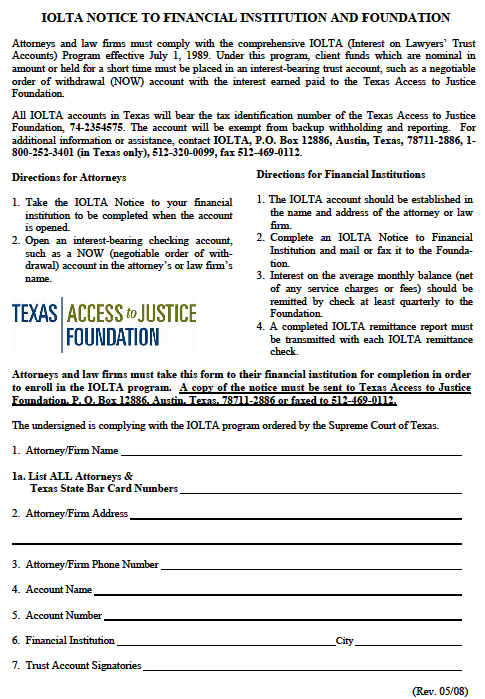
Appendix 6
Annual IOLTA Compliance on SBOT Dues Statement
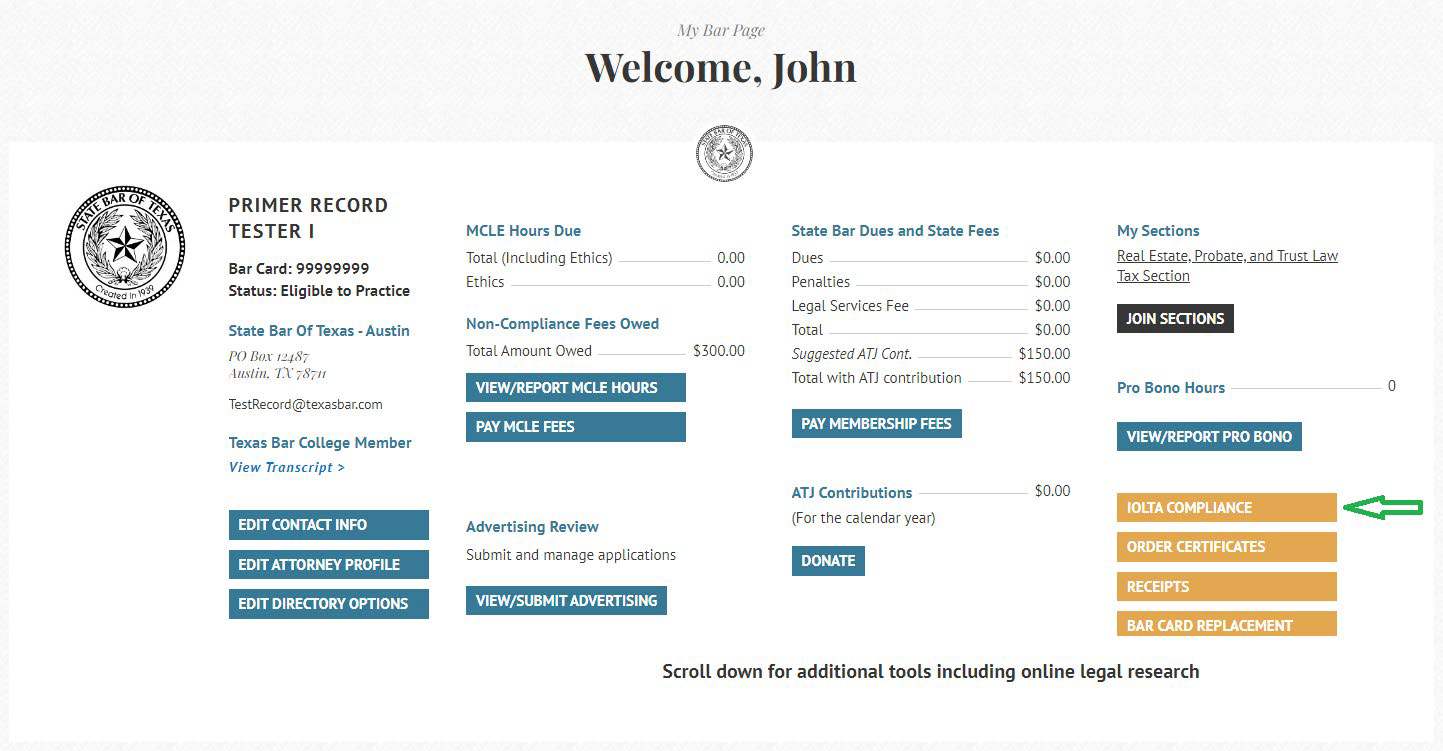
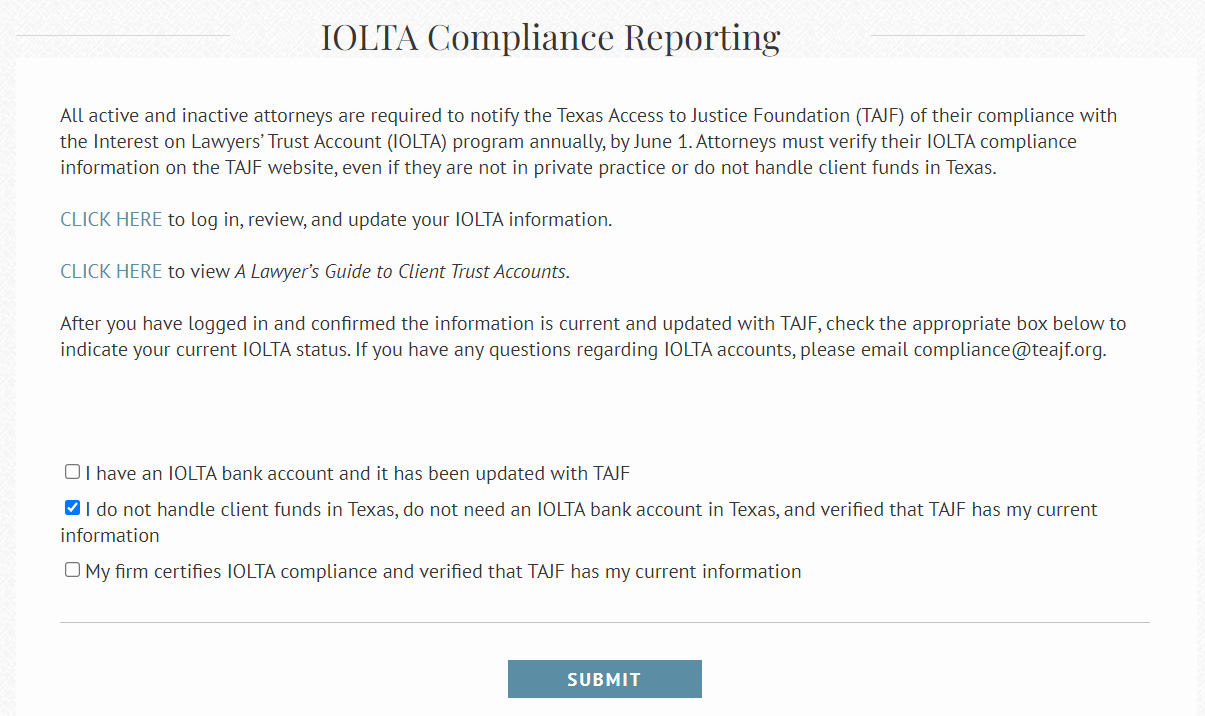
Appendix 7
Ethics Opinion 602
OPINION 602
October 2010

Tex. Comm. on Prof’l Ethics, Op. 602, V. 73 Tex. B.J. 976-977 (2010)
QUESTION PRESENTED

Under the Texas Disciplinary Rules of Professional Conduct, may a lawyer deliver to the Texas Comptroller of Public Accounts, and file related reports concerning, funds or other property held in the lawyer’s trust account for which the lawyer is unable to locate or to identify the owner?


STATEMENT OF FACTS

A lawyer holds in his trust account funds or other property belonging to a client or a third party. After three years, despite reasonable efforts, the lawyer either is unable to locate the client or third party that is the owner of the funds or other property or is unable to determine the identity of the owner.


DISCUSSION

Rule 1.14 of the Texas Disciplinary Rules of Professional Conduct sets forth a lawyer’s obligations regarding funds and other property belonging to clients or third persons. Among other requirements, Rule 1.14(a) requires that a lawyer holding such funds keep the funds in a separate trust or escrow account and that “[c]omplete records of such account funds and other property shall be kept by the lawyer and shall be preserved for a period of five years after termination of the representation.” Rule 1.14(b) provides:


“Upon receiving funds or other property in which a client or third person has an interest, a lawyer shall promptly notify the client or third person. Except as stated in this rule or otherwise permitted by law or by agreement with the client, a lawyer shall promptly deliver to the client or third person any funds or other property that the client or third person is entitled to receive and, upon request by the client or third person, shall promptly render a full accounting regarding such property.”


Further, Rule 1.14(c) includes the requirement that “[a]ll funds in a trust or escrow account shall be disbursed only to those persons entitled to receive them by virtue of the representation or by law.”


Section 72.001(e) of the Texas Property Code defines a “holder” of property as “a person, wherever organized or domiciled, who is: (1) in possession of property that belongs to another; (2) a trustee; or (3) indebted to another on an obligation.” Section 72.101(a) of the Texas Property Code provides that, with exceptions not here relevant:


“. . . personal property is presumed abandoned if, for longer than three years: (1) the existence and location of the owner of the property is unknown to the holder of the property; and (2) according to the knowledge and records of the holder of the property, a claim to the property has not been asserted or an

act of ownership of the property has not been exercised.”


Section 74.301(a) of the Texas Property Code states, in relevant part, that “each holder who on June 30 holds property that is presumed abandoned under Chapter 72, 73, or 75 shall deliver the property to the comptroller on or before the following November 1 accompanied by the report required to be filed under Section 74.101.” Under section 74.101(a) of the Texas Property Code, each holder of property presumed abandoned under chapter 72 (which includes section 72.101(a) quoted above) “shall file a report of that property . . . .” with the Comptroller of Public Accounts. Section 74.101(c) requires that the report include, if known by the holder, certain identifying information about each person who appears to be the owner of the property or any person who is entitled to the property. Under section 74.103 of the Texas Property Code, a holder of property who is required to make such a report must keep for ten years certain records concerning reported property and persons who appear to be owners of such property.


Although this Committee does not have authority to interpret statutory law and no opinion is here offered as to the interpretation of the provisions of the Texas Property Code cited above, for purposes of this opinion the Committee assumes a Texas lawyer could reasonably conclude that in certain circumstances these provisions apply to property held in his trust account for which the owner of the property cannot be located or cannot be identified.


No provision of the Texas Disciplinary Rules of Professional Conduct limits or prohibits the transfer to the Texas Comptroller of funds or property that a lawyer reasonably believes to be “presumed abandoned” under the Texas Property Code. Any delivery of funds required by provisions of the Texas Property Code will be within the scope of Rule 1.14(b), which requires, with exceptions not here applicable, that “a lawyer shall promptly deliver to the . . . third person any funds or other property that the . . . third person is entitled to receive . . . .” Accordingly, if a lawyer concludes that he holds property subject to the delivery requirements of the Texas Property Code, Rule 1.14(b) of the Texas Disciplinary Rules of Professional Conduct not only permits but requires the lawyer to deliver such funds or property to the Comptroller in accordance with the Property Code’s requirements.


With respect to the filing of reports with the Comptroller on property required to be transferred to the Comptroller under the Texas Property Code, it is necessary to consider the requirements of Rule 1.05 of the Texas Disciplinary Rules of Professional Conduct concerning confidential information relating to a lawyer’s representation of current and former clients. Rule 1.05(a) defines “confidential information” to include both “privileged information” and “unprivileged client information.” The latter category is broadly defined in Rule 1.05(a) to mean “all information relating to a client or furnished by the client, other than privileged information, acquired by the lawyer during the course of or by reason of the representation of the client.” Much of the information called for in a report to the Comptroller under section 74.101 of the Texas Property Code appears to come within the definition of “confidential information” under Rule 1.05(a), including, for example, the name, social security number, driver’s license number, e-mail address, and last known address of the client or other person to whom the property is believed to belong.


Rule 1.05(c)(4) expressly authorizes a lawyer to reveal confidential information “[w]hen the lawyer has reason to believe it is necessary to do so in order to comply with a court order, a Texas Disciplinary Rule of Professional Conduct, or other law.” (emphasis added) Thus, if a lawyer files a report containing confidential client information that the lawyer reasonably believes is required under provisions of the Texas Property Code concerning abandoned property, filing such report would not violate the lawyer’s obligations regarding confidentiality under Rule 1.05. It must be emphasized that this authorization applies only to disclosures that are “necessary” for compliance with applicable law. Particularly in view of the general obligation imposed by Rule 1.05 for lawyers not to reveal confidential information acquired in the representation of clients unless an exception such as Rule 1.05(c)(4) applies, the lawyer must take care not to make disclosures that exceed what is required to comply with applicable law. As noted in Comment 14 to Rule 1.05, “ . . . a disclosure adverse to the client’s interest should be no greater than the lawyer believes necessary to the purpose.”


CONCLUSION

Under the Texas Disciplinary Rules of Professional Conduct, a lawyer is permitted to deliver to the Texas Comptroller of Public Accounts, and to file required reports concerning, funds or other property held in the lawyer’s trust account for which the lawyer is unable to locate or to identify the owner, provided the lawyer reasonably believes that such action is required by applicable provisions of Texas law on abandoned property.
Appendix 8
Wilson v. Comm’n for Lawyer Discipline,
BODA Case No. 46432 (January 28, 2011)
Board of Disciplinary Appeals
Appointed by the Supreme Court of Texas
JOE MARR WILSON, APPLELLANT
v.
COMMISSION FOR LAWYER DISCIPLINE OF THE STATE BAR OF TEXAS, APPELLEE
No. 46432
Opinion and Judgment Signed January 28, 2011, and Delivered January 30, 2011
Considered En Banc October 18, 2010
On Appeal from the Evidentiary Panel for the State Bar of Texas, District 13 Grievance Committee No. D01008355970
Opinion and Order
COUNSEL:


Appellant Joe Marr Wilson, Amarillo, Texas, pro se.


For Appellee, Commission for Lawyer Discipline of the State Bar of Texas, Linda A. Acevedo, Chief Disciplinary Counsel, and Cynthia Canfield Hamilton, Senior Appellate Counsel, Austin, Texas.


Judgment Public Reprimand Affirmed.


OPINION AND ORDER:

Appellant, attorney Joe Marr Wilson, appeals from a Judgment of Public Reprimand, alleging that there was no evidence to support a finding that he violated Texas Disciplinary Rule of Professional Conduct (“TDRPC”) 1.14(c).TEX. DISCIPLINARY R. OF PROF'L CONDUCT, reprinted in TEX. GOV'T CODE, tit. 2, subtit. G, app. A (Vernon 2005). The Evidentiary Panel found that Wilson had disbursed trust account funds belonging to his client to himself when he was not entitled to them. We find that Wilson's own testimony and billing statement that he paid himself attorney's fees from funds given to him by his client specifically designated for another purpose is substantial evidence that he disbursed client funds to himself. His conduct violated TDRPC 1.14(c) as a matter of law, and we affirm the Judgment of Public Reprimand signed on December 29, 2009 by the Evidentiary Panel of the State Bar of Texas District 13 (Amarillo) grievance committee.
UNDERLYING GRIEVANCE
The complainant, Donda Haney, hired Wilson in August of 2004 to represent her in a child custody and support matter. Haney paid Wilson $3,500 in advance, and he filed a petition to modify Haney's original visitation order on August 17, 2004. They did not execute a written employment contract. She was to be billed at the rate of $200 per hour. The advance payment was depleted by December 2005. Wilson did not require Haney to replenish this retainer.


Before the trial judge would consider Haney's request to modify the existing custody order, he required her to pay her past-due child support. On, March 5, 2007, the trial court entered an agreed order holding Haney in contempt and ordering her to pay $19,006.51 to her ex-husband. The commitment was suspended on condition that she made scheduled payments under that order. Haney did not comply and was jailed for contempt for 45 days.


In contemplation of negotiating a reduction in her support arrearages, Haney sent Wilson two checks in March 2008: one in the amount of $7,500 (to pay the support arrearages to her ex-husband) and one in the amount of $500 (to pay her ex-husband's attorney's fees). Prior to sending the checks, Haney and Wilson discussed by email the purpose of the money. Wilson deposited both checks in his trust account. In April 2008 Wilson prepared a settlement agreement and transmitted it to her ex-husband's attorney who (Wilson claims) had agreed verbally to accept $8,000 total to settle the arrearage and attorney's fees. He did not forward the money, and it remained in his trust account pending execution of the agreement. Wilson told Haney that he would “maintain control of the money until the appropriate papers are signed.” Wilson stated that the opposing attorney never returned the settlement documents or rejected the verbal agreement. Wilson did not communicate with Haney again until after she fired him.


In August 2008 Haney sent Wilson a letter terminating his services and asking for the return of the $8,000 and her file. Approximately 30 days after receiving the letter, Wilson sent Haney a check in the amount of $1,553.39 with a letter explaining that the check was “a refund of unearned attorney's fees.” Included was a billing statement of services rendered that indicated that Wilson had applied the $8,000 designated for Haney's ex-husband to the amount Wilson determined that Haney owed to him for attorney's fees. This included a $768.75 charge for copying Haney's file. [FN1] There is no dispute that Wilson offset his fees against the $8,000 without Haney's prior knowledge or consent.
SUBSTANTIAL EVIDENCE
Wilson argues that there was no evidence to support a finding that he violated TDRPC 1.14(c) because the Commission for Lawyer Discipline failed to prove that he disbursed any trust account funds at issue to anyone. In support of his argument, Wilson points to finding of fact number three of the evidentiary panel's order: “Respondent [Wilson] disbursed trust account funds, belonging to his client Donda Haney, to himself when he was not entitled to them by virtue of the representation or by law.” Specifically, Wilson says that there is no evidence in the record that the trust account funds were disbursed because he only withheld the funds from his client.


BODA reviews the evidence of a violation of a rule of professional conduct under the substantial evidence standard. TEX. R. DISCIPLINARY PROCEDURE 2.24, reprinted in TEX. GOV'T CODE, tit. 2, subtit. G, app. A-1 (Vernon 2005) (“TRDP”). In deciding whether substantial evidence exists to support the findings of fact, the reviewing body determines whether reasonable minds could have reached the same conclusion. Texas Health Facilities Commission v. Charter Medical-Dallas, Inc., 665 S.W.2d 446, 452 (Tex. 1984) (applying the substantial evidence standard under the APTRA); Allison v. Comm'n for Lawyer Discipline, BODA Case No. 41135 (August 21, 2008). The reviewing court may not substitute its judgment for the decisions within the lower court's discretion and is not bound by the reasons stated in the order for the result, provided that some reasonable basis exists in the record for the action taken. Railroad Comm'n of Texas v. Torch Operating Co., 912 S.W.2d 790, 792 (Tex. 1995). Under substantial evidence review, the findings, conclusions, and decisions of the lower court are presumed to be supported, and the burden is on the appellant to prove otherwise. Substantial evidence is something more than a mere scintilla, but the evidence in the record may preponderate against the decision and still amount to substantial evidence.

City of El Paso v. Pub. Util. Comm'n of Tex., 883 S.W.2d 179, 185 (Tex. 1994).


Wilson is incorrect that there is no evidence that he disbursed the funds contrary to TDRPC 1.14(c). Wilson admitted through his own testimony that he “offset” client trust funds, without the knowledge and consent of the client, to pay his fees. Wilson's transmittal letter to Haney with the refund check characterized the balance of the $8,000 as “payment” for his attorney's fees. The 12-page billing statement Wilson enclosed with the letter covered the period from August 2, 2004 until September 24, 2008 and included an entry for March 20, 2008 of “Payment Received, Thank You” with a credit of $8,000. Wilson violated his duty under Rule 1.14(c) to disburse the funds only to someone entitled to receive them when he sent the letter and billing statement to Haney stating that he had applied $6,446.61 ($8,000 deposited in Wilson's trust account less the $1,533.39 “refund”) of those funds to his own credit and failed to return them to her. We find, therefore, substantial evidence to support the Evidentiary Panel's finding.


Wilson clearly failed to use the funds for the original purpose which Haney had directed and failed to return the money to her when she requested it. At the Evidentiary Panel hearing, Wilson argued that he believed that he was entitled to offset attorney's fees owed by Haney against the $8,000 he held in trust because the original purpose of the funds no longer existed once Haney fired him and because she did not dispute his fees. [FN2] Whether the original purpose no longer existed (which is unclear) or whether Haney disputed his fees is immaterial, because the funds were never given to Wilson to pay his fee. They at all times belonged to Haney who would have had to have affirmatively agreed (not merely fail to object) to allow Wilson to apply the money to his fee. Funds, once entrusted to the lawyer for a particular purpose, can be used only for that purpose, and any unused portion must be returned to the client with a full accounting. See, Brown v. Comm'n for Lawyer Discipline, 980 S.W.2d 675, 680 (Tex. App.—San Antonio 1998, no pet.) (lawyer who retained settlement funds with client's consent and directive to use them for future litigation violated TDRPC 1.14 when he used them for different purpose); 48 ROBERT P. SCHUWERK & LILLIAN B. HARDWICK, TEXAS PRACTICE: HANDBOOK OF TEXAS LAWYER AND JUDICIAL ETHICS § 6:14 p. 979 (2010-2011) (“[F]unds entrusted to a lawyer for a specific purpose can be used only for that purpose: the lawyer must return the unused portion—less any agreed-upon fees earned or expenses incurred—to the client, together with a full accounting.”).


We hold that the lawyer may not unilaterally apply the client's funds held for a designated purpose for another unauthorized purpose without the client's specific consent. This result is consistent with the plain language of TDRPC 1.14 and the intent of the rule. We therefore conclude that Wilson has failed to meet his burden and affirm the Judgment of the Evidentiary Panel in all respects.


IT IS SO ORDERED.


W. Clark Lea

Chair


JoAl Cannon Sheridan

Vice Chair


Alice A. Brown

Ben Selman

Charles L. Smith

Deborah J. Race

Thomas J. Williams

Kathy J. Owen

David A. Chaumette

Jack R Crews

Gary R. Gurwitz


FN1. Ten days before the evidentiary hearing, Wilson refunded the $768.75 that he had charged Haney for copying her file. He conceded at the hearing that, although he thought at the time he could charge for copying the file, he later came to understand it was improper under the TDRPC.


FN2. It is not clear that Wilson ever gave Haney an opportunity to object to his fees before he paid himself. Although Wilson claimed to have sent Haney bills he could not produce copies and admitted that his office did not keep copies. At the hearing, Haney testified that she didn't understand that she owed Wilson money.
Appendix 9
Ethics Opinion 625
OPINION 625
February 2013
Tex. Comm. on Prof’l Ethics, Op. 625, V. 76 Tex. B.J. 362 (2013)
QUESTION PRESENTED
Is it permissible for a lawyer who replaces a client’s prior lawyer in a litigation matter to distribute funds resulting from settlement of the litigation matter without regard to a promise of payment, of which the second lawyer is aware, given to the client’s healthcare provider in a letter signed by the client’s prior lawyer?
STATEMENT OF FACTS
A client in a personal injury case sought treatment from a healthcare provider for injuries sustained in an accident. Prior to providing treatment, the healthcare provider requested and obtained from the lawyer who initially represented the client with respect to the personal injury case a “Letter of Protection” addressed to the healthcare provider. This “Letter of Protection” promised that for medical care provided to the client the healthcare provider would be paid directly out of any settlement proceeds or payment resulting from a jury verdict in the personal injury case.
Thereafter a second lawyer replaced the client’s first lawyer in the personal injury litigation. The second lawyer, who was aware of the “Letter of Protection,” contacted the healthcare provider and attempted to negotiate a compromise of the amount billed by the healthcare provider for services rendered to the client but the healthcare provider refused to discount the amount previously billed. The second lawyer later settled the case, took his agreed fee, and distributed the remaining funds to the client without paying the healthcare provider any amount for the medical services provided to the client for which payment had been promised in the “Letter of Protection” signed by the client’s first lawyer.
DISCUSSION
Rule 1.14(c) of the Texas Disciplinary Rules of Professional Conduct provides as follows:
“When in the course of representation a lawyer is in possession of funds or other property in which both the lawyer and other person claims interests, the property shall be kept separate by the lawyer until there is an accounting and severance of their interest. All funds in a trust or escrow account shall be disbursed only to those persons entitled to receive them by virtue of the representation or by law. If a dispute arises concerning their respective interests, the portion in dispute shall be kept separated by the lawyer until the dispute is resolved, and the undisputed portion shall be distributed appropriately.”
In the circumstances here considered, Rule 1.14(c) requires that the client’s second lawyer keep settlement proceeds to which the client’s healthcare provider has a claim separate until there is an accounting and severance of the interests claimed in these funds by the healthcare provider. Although it is a legal question, rather than a matter of interpretation of the Texas Disciplinary Rules of Professional Conduct, whether and to what extent the “Letter of Protection” signed by the client’s first lawyer binds the client, the client’s second lawyer is aware that as a consequence of the “Letter of Protection” the healthcare provider is claiming an interest in a portion of the settlement funds. In such circumstances, the second lawyer would violate the requirements of Rule 1.14(c) if, before the validity of the healthcare provider’s claim has been conclusively determined, the lawyer distributed to someone other than the healthcare provider the portion of the funds claimed by the healthcare provider. Following the approach suggested in Comment 2 to Rule 1.14 with respect to a dispute between a client and lawyer as to the disposition of funds, it would be appropriate in these circumstances for the lawyer to hold in trust the portion of the settlement funds claimed by the healthcare provider and to suggest a means for prompt resolution of the dispute, such as arbitration.
CONCLUSION
It is a violation of the Texas Disciplinary Rules of Professional Conduct for a lawyer who replaces a client’s prior lawyer in a litigation matter to distribute funds resulting from settlement of the litigation matter without regards to a promise of payment, of which the second lawyer is aware, given to the client’s healthcare provider in a letter signed by the client’s prior lawyer.
Updated January 2024



 LPM Help Center
 Online Subscriptions
 Texas Bar Books