
Join Attorneys Kassi Burns (King & Spalding, LLP) and Trish McAllister (State Bar of Texas, Law Practice Management Department) as they answer questions about confidentiality in the age of AI.


Join Attorneys Kassi Burns (King & Spalding, LLP) and Trish McAllister (State Bar of Texas, Law Practice Management Department) as they answer questions about confidentiality in the age of AI.

Attorneys Seana Willing (Chief Disciplinary Counsel for the State Bar of Texas) and Brad Johnson (Executive Director of the Texas Center for Legal Ethics) join Trish McAllister (Attorney for the Law Practice Management Department) to discuss ethics-related AI questions:

Attorney Joshua Weaver joins Trish McAllister to answer the most pertinent AI-related questions from Texas lawyers.

Alex Shahrestani (Managing Partner, Promise Legal) joins Trish McAllister (Law Practice Management Attorney, State Bar of Texas) to answer even more AI-related questions from Texas lawyers.

What can truly drive consistent, high-quality case flow is relationships—but more specifically, relationships with other attorneys. For new lawyers stepping into solo or small firm practice, this may seem counterintuitive. After all, other attorneys are often viewed as competitors. In reality, they are one of the most reliable and underutilized sources of referrals available.

Artificial intelligence tools have become accessible, practical, and affordable for solo and small firm practitioners. Used thoughtfully, AI can help Texas lawyers maintain a consistent and professional social media presence without adding significant time to an already demanding practice.

Attorney Patrick A. Wright (Board Certified Family Law and Child Welfare Attorney) joins Trish McAllister (Attorney for the Law Practice Management Department) to discuss various AI-related questions.
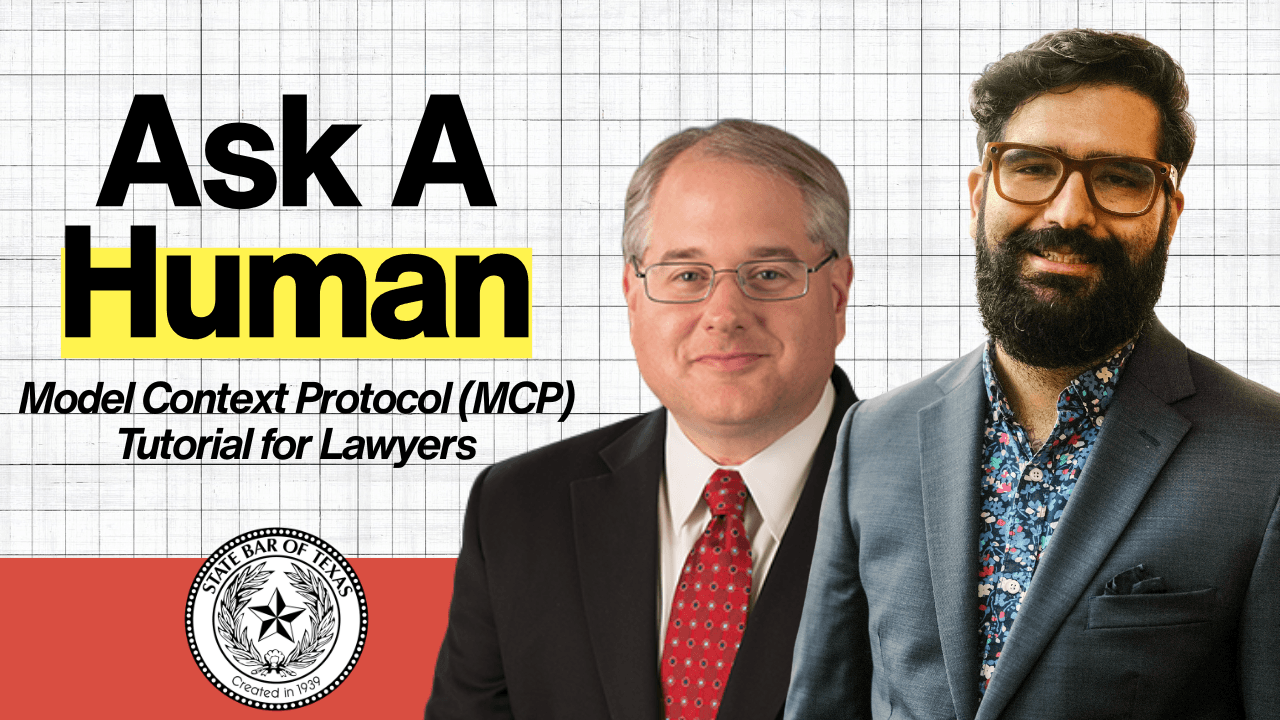
Join attorneys Alex Shahrestani and Patrick Wright in this hands-on tutorial on how to use model context protocol (MCP) to streamline your AI tools.

Watch the second Ask A Human webinar from the Law Practice Management Department of the State Bar of Texas.
 LPM Help Center
 Online Subscriptions
 Texas Bar Books