



Design thinking is a problem-solving process that focuses on the people who are affected by the problem at hand. By using empathy, creativity, and real-world testing, design thinking helps us uncover strategies and solutions that may not be initially obvious.
Although the origins of this process date back to the 1960s, it has expanded beyond the world of design, architecture, and engineering, permeating other industries such as the practice of law.
Simply put, design thinking allows us to look beyond our own immediate surroundings, stretching our minds in such a way that we can ideate more substantially. Design thinking fosters innovation and cultivates creative solutions that not only look good on paper but can be achievable and viable.
Let’s break down the five stages of design thinking.
The Five Stages of Design Thinking
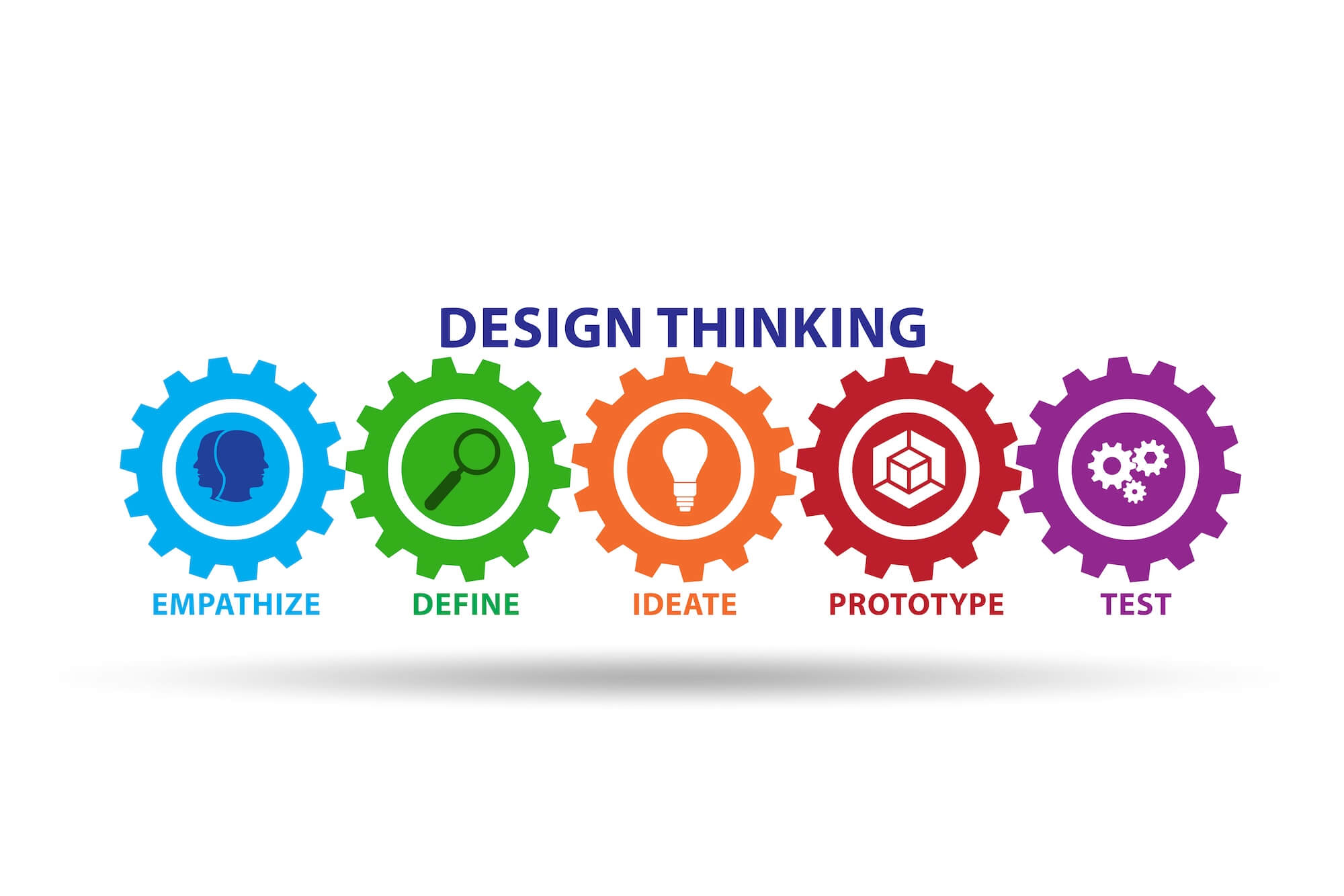
The design thinking process can be broken down into five stages:
- Empathize: Understand the user’s needs and problems
- Define: Analyze your observations to define the problem
- Ideate: Think of solutions to each aspect of the problem
- Prototype: Develop solution prototypes for each aspect of the problem
- Test: Test the product using the best solution identified
Start by fully understanding the problem, finding as many solutions as possible, then testing and refining them until the best result breaks through. This is truly a multi-faceted approach to problem solving and, as such, requires time and focus for the results to be worthwhile.
1) Empathize
Starting off by empathizing with the needs of your users and the problems they face allows you to expand your perspective and look beyond your individual needs. All too often, we hold on to assumptions when formulating solutions. Design thinking seeks to avoid this outcome by asking us to gain a deeper insight into the needs of our clients.
User research is an excellent way to empathize with your clients and see the problems they’re facing as clearly as possible. There are many ways you can do this, including:
- Empathy mapping
- Surveying
- Talking to clients in person
By gaining an empathetic understanding of the problem you’re trying to solve—often through user research—you can begin the “human-centered” design process. Set aside your assumptions and preconceived notions to gain real, tangible insight into your users and their specific needs.
2) Define
In the Define stage, you will state your users’ needs and problems. Begin by accumulating, analyzing, and synthesizing the information you gathered during the Empathize stage. From there, you can define the core problems you have identified.
While in the Define stage, it is crucial to define the problem statement in a human-centered way. Instead of focusing on how the problem statement relates to your business’s bottom line (for example, client growth or revenue increase), frame it around those you are trying to help. In the context of design thinking, statements like “improve communication with new and current clients” work better than “increase billable hours.”
3) Ideate
Now that you’ve laid the foundation, it’s time to let your creativity flow. In the Ideate stage, you will challenge assumptions and create ideas. This is where you can begin to think outside the box. Find alternative ways to view the problem and identify innovative solutions for the problem statement you crafted in the previous steps. During the Ideate stage, feel free to brainstorm without fear of “bad” or crazy ideas. Don’t worry about budget or implementation when considering ideas during this stage.
Whether you’re ideating on your own or with a team, emphasize that there is no judgement at this time. All too often, the first or most general solution is applied to a certain problem, resulting in more issues in the long run. Design thinking seeks to avoid this outcome by devoting more time to finding the right solution. By compiling diverse and unique ideas—no matter how unusual they may seem—you’ll have a greater chance of uncovering the right solution.
Before moving on to the next step, you need to evaluate the ideas your team has compiled. This step is necessary in order to filter out the best ideas from the rest. Give your team the opportunity to ask questions or poke holes in the ideas provided. Before long, you will have a handful of solutions that can evolve beyond the Ideate stage and go into the Prototype stage.
4) Prototype
In the Prototype stage, you will identify the best possible solutions for the problem statement you formulated in the previous stages. This is the stage of trial and error. Your team will work together to identify which solution best solves the problem statement.
Design teams often produce scaled-down, inexpensive versions of the product or feature they’re workshopping. Keep that same perspective in mind during this stage. Start small and manageable to create a prototype you can tangibly implement. If it doesn’t work out, then it won’t be a huge loss of time or money. Try to come up with a handful of “prototypes” instead of just focusing on one. This way, you’ll have other solutions to fall back upon if the first ones don’t solve the problem the way you originally envisioned.
5) Test
The fifth and final stage of the design thinking process is the Test stage. Unlike other processes where the last stage is to implement or release the solution to the public, design thinking continues to focus on empathy. Take the prototype of your solution and test it with your clients. You want the solution to solve their problem, so their input and feedback is necessary in order for it to actually work in the long run. Be open and interactive with your clients and ask them open-ended questions so you can further refine your solution.
Once you receive feedback, you should go back to the previous steps and apply them to your results. As an iterative process, design thinking asks us to continuously refine and improve upon what we’ve already built, resulting in a solution that actually addresses the needs of the clients.
All in all, design thinking may seem overwhelming and time-consuming, but the time spent at the beginning will save you stress and heartache in the long run. By devoting the necessary time and focus to finding the right solutions, you will hopefully find useful, tangible solutions you can implement to improve your bottom line, whatever that may be.
Use Design Thinking to Find Solutions for Your Law Firm
The beauty of design thinking is that it can be used in any industry, including law. Use design thinking to find solutions for common law firm problems, including:
- Balancing daily operation
- Retaining clients
- Hiring top talent
- Economic uncertainty and financial challenges
- Data security and privacy
- Operational inefficiencies
- Growth challenges
- Burnout and employee retention
While most of these problems are internal—where the “client” will be your own employees—design thinking can still be used to remedy complicated issues involving your law firm’s actual clients.
Each step mirrors the client case analysis process. Empathizing with the needs and problems of the client, defining their needs and problems, and ideating solutions for the client in a controlled environment gives you a "clean space" to ponder solutions before bringing them to the client.
During the prototyping stage, you have the ability to think out all reasonable solutions to the fullest, and likewise, the testing phase is comparable to fleshing out the potential solutions in a safe space as reasonable hypotheticals.
Take Your Law Firm to the Next Level with Design Thinking
When it comes to design thinking, the crucial detail to keep in mind is to empathize and allow for open communication. This way, you’ll be able to craft a real solution that you can implement in your law practice.
If you’re looking for more ways to maintain or grow your law firm, make sure to check out the Law Practice Management department.




 LPM Help Center
 Online Subscriptions
 Texas Bar Books